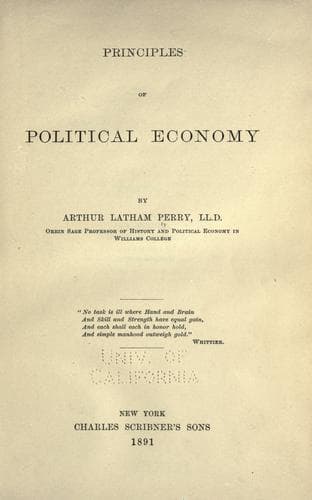
Principles of Political EconomyPerry, Arthur Latham
General
Principles of Political Economy
Perry, Arthur Latham
Economics
the taxes._" England is the only considerable country in the world,
whose customs-revenue increased in the fiscal year 1888-89 over the
year before; this English increase was over 5 _per centum_, which
means an increase both in imports and exports, whose movements are
almost absolutely free so far as England is concerned; while in all
the countries mentioned above, which are under a different system in
that respect, there was a _deficit_ of revenue from tariff-taxes as
compared with the year before, and a _decrease_ in both exports and
imports.
(h) If nearly all bits of valuable lands be capital, as we have just
seen strong grounds for believing, then it follows of course, _that
the Rent of leased lands whether for buildings or harvests is the same
in nature with the Interest on money loaned, and is the measure of the
service rendered by the owners to the actual users of the Capital_.
This proposition, seen in its radical proofs and in its logical
corollaries, takes the very life out of Henry George's land-theories,
and out of the popular remedies thereto annexed. The writer firmly
believes also, that this proposition in the grounds of it and in the
inferences from it might have been used by Mr. Gladstone and his
followers with telling effect in the animated discussions of the Irish
land-question in the British Parliament during the decade 1880-90. In
the debates on the Irish Land Bill passed in 1881, the representatives
of the land-owners in Ireland held to their right to take all the rent
they could extort by the help of the law; on the other hand the
representatives of the Irish rent-payers held to their right as
cultivators and maintainers to withhold rent in large part or
altogether; and Mr. Gladstone, as representative of the nation, while
insisting on the right of the owners to certain rents, insisted
equally on the right of the cultivators to certain important
privileges in the soil. Our present proposition with those that spring
out of it, though it was not used by Gladstone, as it might well have
been to smooth his pathway through the roughness of that legislation,
yet justifies at one and the same time the discontent of the Irish
rent-payer, the claim of the Irish land-holder to an assured rent of
some sort, and the fundamental principle of the Irish Land Bill of
1881. That bill gives a certain modified ownership and control to the
actual cultivators and maintainers of the soil. That is right.
Public-domain text, read in full here on John Shaqi.
Reviews
Reviews
No reviews yet
Be the first to share your thoughts on this work.
Elsewhere in the archive
Join the Discussion
Join the discussion
Sign in to leave a comment or review.
Sign InorCreate an account