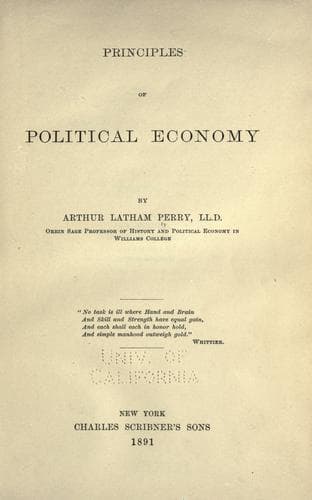
Principles of Political EconomyPerry, Arthur Latham
General
Principles of Political Economy
Perry, Arthur Latham
Economics
(i) If the bulk of all valuable land-parcels be capital, as it is,
then one might expect beforehand to find _a law of diminishing
returns_ from such lands, agricultural labor and skill remaining the
same; because, all capital is tools made such by the expenditure of
human efforts on changeable material, and then by the practice of
_abstinence_, and tools from their very nature are always wearing out.
Increase of efforts in connection with any form of capital unimproved
by new inventions and uninvigorated by fresh skill, though they may
indeed increase the aggregate return, cannot, for the reason just
given, _secure an increase proportioned to the increase of the
efforts_. The English writers generally, and Mr. Ricardo in
particular, justly lay much stress on this proposition, although they
have not taken lands to be capital, and have proven the law of
diminishing returns in a different way from ours, and consequently
have not set the propositions of land in their best and most ultimate
relations. Their method of proving the law, however, is short and
conclusive: If by doubling the efforts upon a piece of land, double
the produce could be secured, and by quadrupling it, quadruple, and so
on, there would be no reason why any man should ever cultivate more
than a square acre, or even a square rod. He has a strong motive to
confine his culture to a small space, just so long as the amount of
produce is in the ratio of the efforts expended, because there is less
locomotion of tools and fertilizers and crops. The fact that he
extends his culture from one acre to another, and then to distant
acres, notwithstanding the inconvenience and expense of
transportation, is an irrefragable proof of the proposition in
question. Increase of agricultural efforts and expenditures on a given
space of land will secure a larger amount of produce, but as a general
law, _the increased amount will not be proportioned to the increased
expenditure_.
It is through this law of diminishing returns, that the Creator has
secured the gradual occupation, by men, of almost the whole earth.
There is a strong and natural tendency to leave the old acres to
advance upon new, the old countries to emigrate to new, whenever the
returns begin to bear a more unfavorable ratio to the labors bestowed.
The farmer will advance from the first to the second acre as soon as
he thinks that more produce can be obtained from it by a given amount
of efforts than can be gotten by a like expenditure of additional
efforts upon the first acre, allowance being made for the increased
inconvenience; and so, cultivation has gradually extended itself and
men have become dispersed over the whole earth. Other principles
leading to dispersion have undoubtedly co-operated, but this is the
fundamental one, operative at all times, changing the course of
population, and consequently of empire.
Public-domain text, read in full here on John Shaqi.
Reviews
Reviews
No reviews yet
Be the first to share your thoughts on this work.
Elsewhere in the archive
Join the Discussion
Join the discussion
Sign in to leave a comment or review.
Sign InorCreate an account