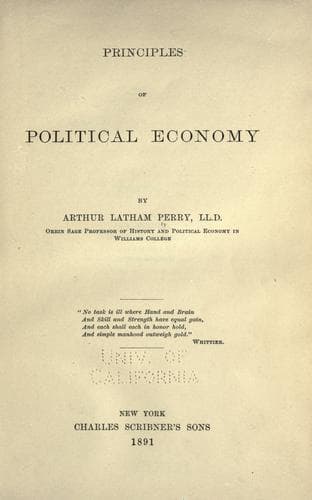
Principles of Political EconomyPerry, Arthur Latham
General
Principles of Political Economy
Perry, Arthur Latham
Economics
The principle of land-values herewith enunciated, their uprise and
increase and frequent decay also in all land-parcels, justifies
completely the concessions to tenants in that bill; while the old and
still commonly accepted English principles of land, and the false yet
famous doctrine of Rent promulgated by Ricardo at the beginning of the
century, are wholly against Gladstone and his concessions in that
bill. Let us now see whither simple analysis and logical processes
will quickly bring us in this whole matter. Valuable land was once
valueless, and always remained so, until, by virtue of human efforts
expended upon it or in some direct connection with it, coupled with
the desires of certain other men for that land or its produce,
accompanied with a readiness on the part of these men to render some
equivalent for it or its use, first imparted value to that particular
patch; moreover, it has been found in practice ten thousand times,
just as one would expect, knowing the origin of value in general,
that, unless human efforts are further and constantly expended on or
in connection with that piece, and unless desires of other men
continue to turn towards it in the way of exchange, its value will
silently and inevitably escape from it; therefore, whoever has come
into possession of that valuable piece of land by purchase or
inheritance, and foregoes the use of it in favor of another as a
tenant, is morally and commercially entitled to the stipulated return
for that use, _which is rent_; but also, if that other, aside from the
current use which is always a wearing-out process, contributes in any
way to the continuance and increase of the value and fertility of the
land, then and so far he gains rights in the land and becomes a sort
of joint owner of it, since what he has done in the way of maintenance
and improvement is inextricably mingled with what the other owners or
users have done, and is of the same nature with that; and, therefore,
the modified ownership of certain tenants recognized in Gladstone's
bill is in strict accordance with ultimate justice, as it is also in
strict accord with right, that the legal owner should continue to
receive a return in the shape of rent for all the fertility and
opportunity actually contributed by him, and no more. The discontent
of the Irish peasantry has largely come from an instinct or
intelligence more unerring than the economics of the land-owners,
namely, that they are called on to pay rent for what they themselves
have _contributed_ in addition to the rent for what they have
_received_. The true origin of value in land, and the only way in
which value in land is kept up, seems to have penetrated deeper into
the minds of Irish tenants than into the minds of many British
statesmen.
Public-domain text, read in full here on John Shaqi.
Reviews
Reviews
No reviews yet
Be the first to share your thoughts on this work.
Elsewhere in the archive
Join the Discussion
Join the discussion
Sign in to leave a comment or review.
Sign InorCreate an account