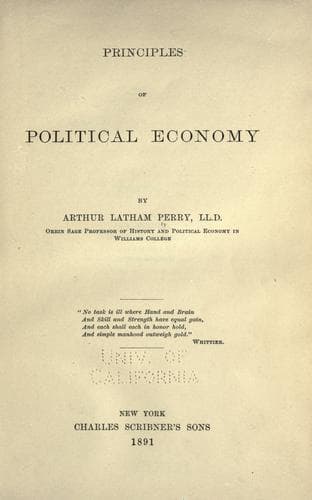
Principles of Political EconomyPerry, Arthur Latham
General
Principles of Political Economy
Perry, Arthur Latham
Economics
It is a cognate point yet worthy of separate mention, that a general
division of lands into farms only moderately large and approximately
equal is most favorable to the largest aggregate production. Such a
division takes place of itself wherever the lands are held in fee
simple, and the cost of land-transfers is slight, and there are no
such obstacles as slavery or primogeniture, as has happened
practically in New England and in the Middle and Western States, and
as is now happening of its own accord more or less at the South. The
Greek writer, Aristotle, quoted some centuries before Christ from "the
African," probably some Carthaginian writer on agriculture, the now
familiar saying, "_the best manure for the land is the foot of the
owner_." This homely word long attributed to Dr. Franklin, who stole
it for his "Poor Richard's Almanack" more than a century ago, is based
on the sound principle, that personal supervision to be most effective
must be limited in its sphere, and that the best agricultural skill
becomes weak when it attempts to exhibit itself on too broad a
surface. Because a man can cultivate 100 acres better than any of his
neighbors, it does not prove that he will cultivate 50 acres
additional to them better than a neighbor of inferior skill, who is
the owner of these 50 and no more. When the freeholds are small and
nearly equal a wide competition among the farmers comes naturally into
play, success is seen to depend upon personal efforts of intelligence
and will, and interest and hope become the motives to the most
productive cultivation. There is a high pleasure in possession and in
self-guided exertion, and an impulse is broadly felt over the whole
region to get as much as possible out of the land and at the same time
to keep good and ever improve its condition. To protect and advance
his own interests, to attend upon the seasons, to watch and wait, to
foresee and plan and labor,--all this develops the farmer, and gives
him energy and independence; and wherever there is a broad basis of
such independent yeomanry to lean back upon, when heavy taxes are to
be raised and strong blows of battle are to be struck, the national
safety and position are assured.
Public-domain text, read in full here on John Shaqi.
Reviews
Reviews
No reviews yet
Be the first to share your thoughts on this work.
Elsewhere in the archive
Join the Discussion
Join the discussion
Sign in to leave a comment or review.
Sign InorCreate an account