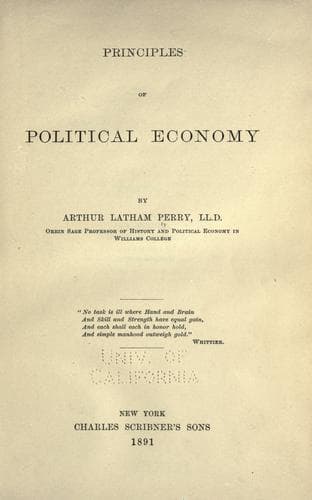
Principles of Political EconomyPerry, Arthur Latham
General
Principles of Political Economy
Perry, Arthur Latham
Economics
6. We come now in the last place to consider the _Costs of Production_
of material commodities of all sorts. Valuable patches of land, all
prepared for Production in its several kinds, are the most important
Commodities in the world, and the largest also in volume of Value.
What did it cost "_to subdue_" the present tillable lands of this
country? How much did it cost to get ready for grazing the broad
pastures? To make accessible the forests that yield the timber? To
open up the mines also and bring them into "touch" with the
population? These questions are of great consequence, not that the
actual past cost of any class of these more permanent "commodities" in
the commercial world will be any safe guide to their present value,
since cheaper and cheaper means of subduing the rugged forms of Nature
are all the while coming into play, and all things that did cost more
once tend pitilessly to fall to what similar things cost now; and
since also it is never "efforts" alone that determine the value of
anything, but efforts in conjunction with the "desires" of other men.
Still, the _amount_ of efforts expended at any given time upon these
more stable commodities to make them productive, that is, their cost
of production, is always gauged in general by an _estimate_ of what
the "desires" for them will be when completed; and this makes their
cost of production a sort of loose measure of their value at the time.
The main reason, however, why the cost of production of these primal
commodities, namely, valuable land-patches, whatever may be expected
to be produced from them afterwards, is so important, is, that as a
general rule, the less the cost of any commodity meeting a universal
want _the wider and surer is its market_. The larger the circle of the
buyers of anything the more certain its sale; because, the world over,
the men of small incomes are manifold larger in number than the men of
large incomes. Society is like a pyramid: the lowest course of masonry
is the longest and widest,--has the most stones or bricks in it,--and
ever fewer towards the top.
Public-domain text, read in full here on John Shaqi.
Reviews
Reviews
No reviews yet
Be the first to share your thoughts on this work.
Elsewhere in the archive
Join the Discussion
Join the discussion
Sign in to leave a comment or review.
Sign InorCreate an account