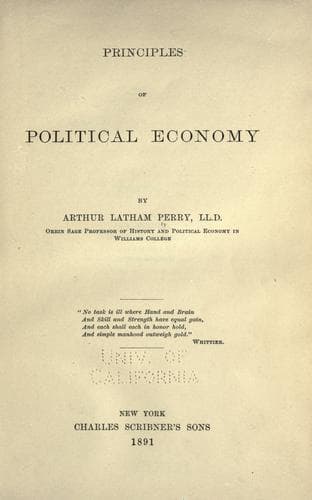
Principles of Political EconomyPerry, Arthur Latham
General
Principles of Political Economy
Perry, Arthur Latham
Economics
Now the cost of Labor is analyzable into three variables only, namely,
(1) the _efficiency_ of the labor; (2) the _rate_ of nominal wages
paid; (3) the cost to the employer of _that valuable_, in which the
wages are paid. Let us see: what an employer wants _is to get things
done_; consequently, if an employer hire two men to work for him at
the same rate of wages, and if one be twice as efficient a laborer as
the other, the _cost_ of the labor of the first is only one half the
cost of the labor of the second: therefore, a _high rate of wages_
does not mean _a high cost of labor_ whenever and wherever the
laborers are very efficient. As a rule, it is found, that the cost of
labor in reference to a given product is _the least_ in those
countries, like the United States and Great Britain, in which the
rates of nominal wages are _the highest_; because, it is found also,
that a high _efficiency_ of laborers accompanies both as a cause and
as an effect high rates of wages.
Secondly, there are striking differences in the rates of nominal wages
paid for a day's work in the same general employment in different
parts of the same country, and especially in different countries. The
agricultural laborer in the west of England, say in Wiltshire, gets
about 10_s._ per week, while in the north of England, say
Nottinghamshire, laborers at the same general work get about 16_s._
per week. Walker in his Wages-Question gathers from the best
authorities many such statements as these: "On the Grand Trunk Railway
in Canada the French-Canadian laborers received 3_s._ 6_d._ a day,
while the Englishmen received from 5_s._ to 6_s._ a day, but it was
found that the English did the greatest amount of work for the
money." "In the quarry at Bonnieres, in which Frenchmen, Irishmen, and
Englishmen were employed side by side, the Frenchmen received 3, the
Irishmen 4, and the Englishmen 6, francs a day; and at those different
rates the Englishman was found to be the most advantageous workman of
the three." "The statistics of the iron industry in France show, that
on the average 42 men are employed to do the same work in smelting pig
iron as is done by 25 men on the Tees." "In India, although the cost
of daily labor ranges from 4-1/2_d._ to 6_d._ a day, mile for mile,
the cost of railway work is about the same as in England." Thus it is
plain, that a _high rate of wages_ does not import a _high cost of
labor_, but rather the reverse. A vast mass of current fallacies are
disposed of in a moment by this truth seen in its grounds. The United
States have shown in the past the highest rates of nominal wages in
the world, and at the same time have shown the lowest costs of labor
to the employers, because as a rule the laborers here have been more
efficient than elsewhere. England has the highest rates of wages and
the lowest costs of labor in Europe for the same reason. The degree of
_efficiency_ shown by different laborers is the second variable in a
cost of labor.
Public-domain text, read in full here on John Shaqi.
Reviews
Reviews
No reviews yet
Be the first to share your thoughts on this work.
Elsewhere in the archive
Join the Discussion
Join the discussion
Sign in to leave a comment or review.
Sign InorCreate an account