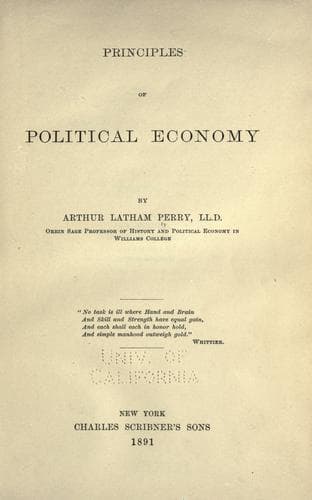
Principles of Political EconomyPerry, Arthur Latham
General
Principles of Political Economy
Perry, Arthur Latham
Economics
Thirdly, if that valuable, whether money or other, in which wages are
paid, varies in cost to the employer, then the cost of the labor paid
for by that valuable, efficiency of the laborers, and nominal rate of
pay remaining the same, will of course be varied thereby. We shall
learn hereafter in the chapter under that title, that the value of
"Money" is by no means invariable even in one country, just as we have
already learned the variable nature of all other values; and, too,
wages are not always paid in money, though they are commonly reckoned
in the terms of money; and accordingly, the third and last variable
in a cost of labor is the cost to the employer of that valuable,
whatever it be, in which the wages are paid. Assuming, as we may, that
given wages are paid in money, then any country that has for any
reason a more abundant money than another may clearly pay higher rates
of nominal wages than that other without making its costs of labor any
higher than in that. The United States, for example, has usually had a
very abundant money (not always of the best kind), which of course has
tended to make higher the current prices of all commodities, and this
has enabled capitalist-employers to pay higher nominal rates of wages,
without at all enhancing relatively the costs of labor, and also
without really benefiting the laborers.
(b) We will now analyze second the Cost of Capital in this connection,
as the only other element of cost in the Cost of Production of
Commodities in general, and particularly now in the cost of making
worthless land-pieces valuable so as to be used in further production.
Here too we find three variables, no one of which can be safely
neglected any more than the other three in the reckoning that has for
its object a prospective cost of production. These are, first, _the
current rate per centum_; second, _the time for which the capital is
advanced_; and third, _the liability of that form of capital to slow
or rapid wearing out_. For instance, under the first variable, the
rate per centum of capital, if the rate at Amsterdam be 3 and that at
New York be 7, if the cost of labor be equal in the two cities, if the
time of advance be one year, and if there be no liability of the
capital to wear out; then any commodity made at Amsterdam with an
outlay of $100 may be sold at a profit for $103, while a similar
commodity made at New York with the same outlay cannot be sold for
less than $107. All other things being equal, a _low rate per centum_
of capital in any country gives that country an advantage in the
markets of the world for selling its commodities over other countries
offering similar commodities where the rate is higher, because its
cost of their production is less. Of course also such a country can
subjugate its wild lands and make them valuable at less cost than the
other countries.
Public-domain text, read in full here on John Shaqi.
Reviews
Reviews
No reviews yet
Be the first to share your thoughts on this work.
Elsewhere in the archive
Join the Discussion
Join the discussion
Sign in to leave a comment or review.
Sign InorCreate an account