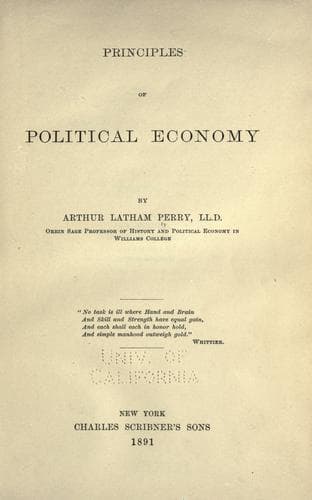
Principles of Political EconomyPerry, Arthur Latham
General
Principles of Political Economy
Perry, Arthur Latham
Economics
The capitalist, therefore, can sell B for $1200, and make
something over the current rate of profit.
Since the cost of capital invariably resolves itself into these three
variables, every capitalist in order to become successful as such must
give strict attention to all three of these points. To any one who
projects the making of valueless into valuable land, or valuable into
more valuable land, by the expenditure of capital upon them for that
purpose, it becomes a matter of prime importance for him to inquire
how long a time the whole process will take, how much he must allow
_per annum_ for the cost of all the implements employed, and
especially how complete in action and duration are these costly
implements. The _durability of machinery_, whatever the name it bear
and whatsoever the work it do, is at once the most significant and the
most neglected point in the actual and prospective Production of our
time and country; and no condemnation can be too severe upon a policy
of public law, such as now prevails, whose whole tendency and actual
effect is to worsen the quality and lessen the durability of all
commercial implements whatsoever, from the needle to the locomotive.
The same abominable public policy increases the cost and decreases the
durability of all agricultural implements, like the axe and the
plough, designed and adapted to transform valueless and non-productive
into valuable and food-producing lands.
_2._ Now, having fully seen the elements of the cost of reducing land
itself from a natural into a valuable and productive form, what next
are the elements of the cost of production of those material
commodities produced for sale _by the aid_ of these subdued and now
productive lands? Commodities so produced constitute the second class
in the law of their Cost of Production. And a vastly important class
it is. The food of the world, so far as that food is purchased as the
product, whether animal or vegetable, of valuable lands; the fuel of
the world, so far as that fuel is bought from owned and accessible
forests and mines; the clothing of the world, so far as the fabrics
come from the cultivated cotton and flax and wool and skins offered
for sale; the shelter of the world, so far as the wood and brick and
stones and lime are drawn from valuable lands and quarries; and the
warehouses and the temples and the theatres of the world, built, as
they are, out of the products of costly and rentful lands: these all,
and many more like these, constitute a class of commodities immense in
their volume, whose cost of production has in it an element peculiar
and additional to that of the first class already analyzed, and to
that of the third class also soon to be considered.
Public-domain text, read in full here on John Shaqi.
Reviews
Reviews
No reviews yet
Be the first to share your thoughts on this work.
Elsewhere in the archive
Join the Discussion
Join the discussion
Sign in to leave a comment or review.
Sign InorCreate an account