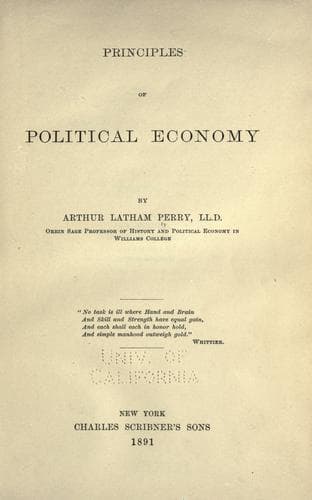
Principles of Political EconomyPerry, Arthur Latham
General
Principles of Political Economy
Perry, Arthur Latham
Economics
To illustrate the operation of the second variable, the time for which
the capital is advanced, let the same suppositions be continued,
except that the _time of advance_ at New York be extended to four
years. Then the commodity may be sold at and from Amsterdam, as
before, at $103, but the corresponding commodity at and from New York
for not less than $131, so far as mere cost of production determines
the prices. This point is also well shown up in the case of wine,
which, to reach its perfection, requires to be kept a number of years,
for, if it be genuine and ripe, its cost of production has been by so
much enhanced by its delay in reaching the market. If the time of
advance be long, and the rate _per centum_ high at the same time, the
cost of capital from the two causes combined multiplies the cost of
the product; and consequently, only countries in which the _rates_ are
low can successfully engage in enterprises requiring a large capital
to be invested for _long periods_ before returns are realized. One
million of Dutch capital at 3% a year, expecting to realize returns
only after 20 years, may be remunerated by products selling for
$1,806,111; but American capital under like circumstances, except that
the rate here is 7%, must have a return of $3,869,685, or lose by the
operation.
To illustrate the action of the third and last variable, we must
observe, that all forms of capital wear out, but some forms much
faster than others, and that this makes a difference in the
sinking-funds that must be reserved out of the gross profits of the
capital in order to replace the principal whole. This difference will
at once affect the cost of capital, and so of production, and so
indirectly the ultimate value of the product. Suppose there are two
commodities, which we will call A and B, produced in two different
establishments, in each of which is invested a capital of $11,000, in
one of which is used a machine that costs $1000 and is wholly worn out
by one year's use, and in the other a machine costing the same sum,
which will last, however, for ten years. Suppose further, that the
rate _per centum_ of profit be 10, and the time consumed in completing
each of the two products be one year. Now there is a marked difference
in the Cost of Capital in the two establishments, and this difference
will indirectly but immediately appear in the Value of the respective
products. For, to A must be charged not only $1100, the interest on
the whole capital at the current rate, but also another $1000,
wherewith to replace the machine already worn out by a single year's
use. A, accordingly, cannot be sold without loss for less than $2100.
B, however, will cost less and can be sold for less at the usual
profit. Because, to it must be charged, as before, $1100, current rate
of profit on the capital invested, and only $100 (really less than
that for an obvious reason) to replace the durable machine after ten
years' use.
Public-domain text, read in full here on John Shaqi.
Reviews
Reviews
No reviews yet
Be the first to share your thoughts on this work.
Elsewhere in the archive
Join the Discussion
Join the discussion
Sign in to leave a comment or review.
Sign InorCreate an account