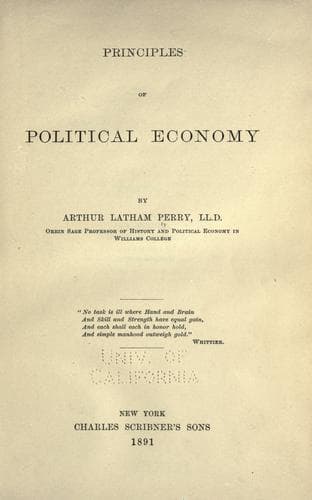
Principles of Political EconomyPerry, Arthur Latham
General
Principles of Political Economy
Perry, Arthur Latham
Economics
(b) It is also very easy to see, that the current price of produce,
that is, what is gotten in return for the sale of what is gotten out
of the land-parcels, must have a dominant influence upon what can be
paid as rent for the use of the parcels. Unless the return from the
produce be sufficient to reward at current rates the present labor and
capital employed upon the parcel, the parcel will not continue to be
cultivated at all, otherwise men would act without a motive for
action, which they never do; unless, therefore, the price of produce
be more than high enough to repay current wages and profits, there
will be nothing left for Rent; and, consequently, the amount of the
rent that can continue to be paid for lands will be _the difference
between the going price of what is produced from them and the current
expenses of cultivating them_. Here, as everywhere else within the
domain of Exchange, Competition exerts its beneficent action. If one
dealer, or ten, endeavors to put a price upon the produce more than
enough to pay current wages and profits with a fair margin for the
diminishing rate of rent, there are a plenty of others, dealers in the
same grade of produce, who will be content with a fair return for
present and past expenditure of labor and capital; and the action of
these will effectually debar the others from exorbitant rates. The
price of produce, accordingly, under free competition, is the divinely
appointed regulator of landed rents. It regulates also, though more
indirectly, the current rates of wages and profits in agriculture.
Public-domain text, read in full here on John Shaqi.
Reviews
Reviews
No reviews yet
Be the first to share your thoughts on this work.
Elsewhere in the archive
Join the Discussion
Join the discussion
Sign in to leave a comment or review.
Sign InorCreate an account