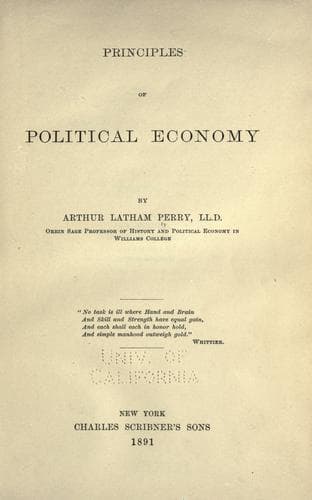
Principles of Political EconomyPerry, Arthur Latham
General
Principles of Political Economy
Perry, Arthur Latham
Economics
Very different from this is Ricardo's doctrine of Rent. He makes
everything turn on the Cost of Production of the Produce, which is
Effort, ignoring the ever-varying demands for the produce, which is
Desire. His doctrine, too famous and too long received for us to pass
by in this connection, though now superannuated, was for substance,
this: there are some lands in every country whose produce just repays
the expenses of cultivation, and consequently yields no margin for
rent; and the cost of production on these rentless and poorest lands
under cultivation, will determine the price of the produce; and as
there can be but one price in the same market, the produce raised on
more fertile land will be sold for the same price, and this price,
besides paying the cost of cultivation, will yield a rent rising
higher according as the land is more fertile; so that the rent paid on
any land is always a measure of the excess of productiveness of that
land over the least productive land under paying cultivation; and
therefore, an increased demand for food in consequence of increased
population, and the higher price resulting, will force cultivation
down upon still poorer soils, or compel a higher culture for less
remunerative returns on the old soils, according to the law of
diminishing returns, which in either case will raise the rents on all
the soils above that grade that just repays the expenses of
cultivation; so that it is the sole interest of landlords, as such,
that population should be dense and food high, their interest being
directly antagonistic to that of the other classes of the community.
Public-domain text, read in full here on John Shaqi.
Reviews
Reviews
No reviews yet
Be the first to share your thoughts on this work.
Elsewhere in the archive
Join the Discussion
Join the discussion
Sign in to leave a comment or review.
Sign InorCreate an account