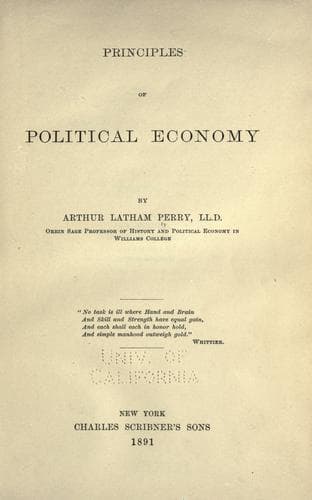
Principles of Political EconomyPerry, Arthur Latham
General
Principles of Political Economy
Perry, Arthur Latham
Economics
secret so-called "Trusts" about forty more of the necessaries of life;
each one of which, unless it be the "Standard Oil Trust," has its
footing in a so-called "protective" tariff-tax, and would collapse
instantly on the repeal of that!
It was necessary in order to complete our study of the second class of
material commodities, namely, those produced from valuable and rentful
lands, to glance in passing at the frequently disturbing effect on
these, aside from their cost of production, of sinister laws plausibly
imposed upon an unsuspicious people in the interest and at the
instance of a privileged few.
_3._ It only remains in this chapter, devoted to the discussion of
material Commodities in their three economic classes, to conclude
with a glance at the third class, namely, those material valuables
that are obtained from free and unowned sources, such as masts cut in
the wilds of America on both oceans two and three hundred years ago,
and fish caught on the Banks of Newfoundland, and furs gathered to
such profit in the north by the Hudson's Bay Company, and salt
evaporated in the tropics by a free sun from old ocean's brine.
These, and all such things as these, have a cost of production
determined only by the cost of present labor and capital, and
consequently a grade of value determined only by present Demand and
Supply, unentangled for the most part by questions of rent and prior
claim and taxation and nationality. All these things, accordingly, are
relatively cheap, except as the element of Scarcity, and on that
account of strong Desire, may sometimes come in to enhance the value.
No man can tell the time exactly when French fishermen from the coasts
of Brittany ventured over to the Banks of Newfoundland in their frail
barks for the abundant cod in those waters, and went back home again
at the close of the season freighted with plenty of a free and cheap
food for their families and countrymen; or when it was that rude men
calling themselves English followed these in their western track for
the same general purposes, to become thereby hardy seamen on deeper
seas, such as those who gained long afterwards the naval victories of
Nelson; and we have all read in the fascinating pages of Irving the
ventures and adventures of John Jacob Astor, the attraction of free
furs in the Northwest of America, the hazards and the history incident
to obtaining them, and the immense profits gained by their sale in the
markets of the old world.
FOOTNOTES:
[3] Baines' History of the Cotton Manufacture, as condensed and quoted
in Walpole's History of England, Vol. I.
[4] Charles Knight's History of England, III. 292 _et seq._
CHAPTER III.
PERSONAL SERVICES.
Public-domain text, read in full here on John Shaqi.
Reviews
Reviews
No reviews yet
Be the first to share your thoughts on this work.
Elsewhere in the archive
Join the Discussion
Join the discussion
Sign in to leave a comment or review.
Sign InorCreate an account