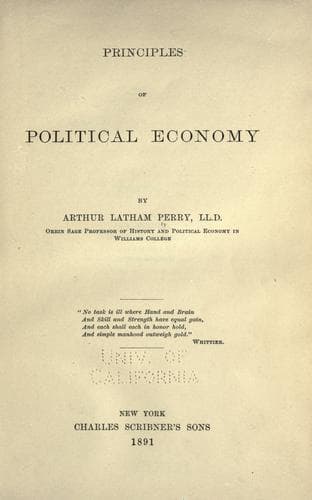
Principles of Political EconomyPerry, Arthur Latham
General
Principles of Political Economy
Perry, Arthur Latham
Economics
At the present moment and for twenty-five years past, the public laws
of the United States ostensibly relating to Taxes, have had an immense
influence upon the value and rents of the agricultural lands of the
country to depress them; because these laws have put up nearly or
wholly impassable barriers to the coming in of those foreign goods,
against which the farmers would naturally and profitably and
inevitably have sold their surplus agricultural produce; by destroying
the foreign market for farm products, these laws do in effect destroy
a large part of the value of the farms of the country, and of what
would otherwise be the rentals of a part of them; the Constitution of
the country expressly forbids any taxation whatever of Exports, but
these laws have precisely the same effect on the value of farm
products if they were themselves forbidden to be exported, because
those goods for which these would be otherwise exchanged for a profit
are forbidden to be imported. _A market for products is products in
market._ Thus these wretched laws lower the price of farm products,
and consequently the value of farms and of their rents, and impoverish
the farmers who are nearly one-half of the entire population of the
country.
While these paragraphs are being written, comes the intelligence of
the formation of the "North American Salt Company," whose purpose is
in their own language "_to unify and systematize the salt interests of
the United States and Canada_," and to this end "_arrangements have
been completed for the purchase and control of nearly all the existing
salt properties of the North American continent_." As this is a fair
instance out of some thousands, in which a tariff-tax has the designed
effect to lift or lower values which deeply concern the people, let
us look at it for a moment. On the average of the past twenty-five
years the tariff-tax on salt has in general doubled the cost of that
necessary of life to the whole people of the United States. When
Canada had no such tax, American makers of it sold salt sometimes to
the Canadians 40% less than they would sell it to their own
countrymen. On the basis of this United States tariff-tax (it would
never have been dreamed of without it) this new company comes forward
with a scheme of international monopoly to control in their own
interest the price of a prime necessity of life. They propose to issue
stock and bonds to the amount of $15,000,000, with which to buy up
"the existing salt properties"; and they frankly avow in the
prospectus from which we are quoting, that profits of $2,000,000 a
year on their capital are justified by the present outlook. Whence are
these immense profits to come? Out of the pockets of the masses of the
American people bound hand and foot in the meshes of a legal monopoly,
which they themselves allow themselves to be ensnared in! In a similar
but more outrageous way, are bound up at the present moment in the
Public-domain text, read in full here on John Shaqi.
Reviews
Reviews
No reviews yet
Be the first to share your thoughts on this work.
Elsewhere in the archive
Join the Discussion
Join the discussion
Sign in to leave a comment or review.
Sign InorCreate an account