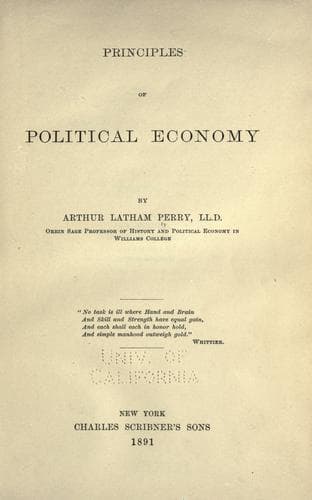
Principles of Political EconomyPerry, Arthur Latham
General
Principles of Political Economy
Perry, Arthur Latham
Economics
Right here we may see clearly the main objection to the term, "Labor,"
as commonly used, and the bad fallacy to which it gives birth. "Labor"
is indeed in form and origin an _abstract_ term as much as "service"
is, with this difference, that the word "service" radically implies
the person serving and another person served at the same instant; but
the term "Labor" has long been taking on itself in the mouths of men a
_concrete_ meaning, as if it might be something separate from the
laborers, as in the common phrase "Labor and Capital," which has
already done a world of mischief and is likely to do a good deal more,
because it seems to imply, that the two are alike in independent
self-existence, and that they stand over against each other on equal
terms for a fair bargain or for a free fight. This is not the case, as
we shall see more fully later; since capital is something separable
from the capitalist, always a commodity or a claim, always
transferable, always valuable or else it will not be "Capital." Some
of the German economists, and particularly John Conrad of Halle, have
avoided this difficulty by a clean nomenclature. They say
"_Labor-givers_" and "_Labor-takers_," instead of Laborers and
Capitalists, and especially instead of "Labor and Capital," thus
emphasizing the personal element in both terms, and also leaving
themselves free to define and use the term "Capital" as distinct from
any particular capitalist, while the term "Labor" cannot be defined
and used as distinct from any given laborer. This precise point,
though probably new, is of very considerable consequence in the true
doctrine of Wages.
We are compelled by the exigencies of the English language and the
still stronger fetters of economical custom to continue to use the
terms "Labor" and "Laborers" in their technical sense, and in
connection with the scientific terms "Capital" and "Capitalist"; but
we shall always use each of these words in the same meaning, and free
them as far as possible from the fungous accretions that have fastened
upon them in the course of time.
_Personal effort of any kind put forth for another in view of a
return-service and for the sake of it is labor._
_Laborers are persons rendering their peculiar services to other
persons for a commercial reward._
_The valuable received by a laborer for his service rendered is
Wages._
Public-domain text, read in full here on John Shaqi.
Reviews
Reviews
No reviews yet
Be the first to share your thoughts on this work.
Elsewhere in the archive
Join the Discussion
Join the discussion
Sign in to leave a comment or review.
Sign InorCreate an account