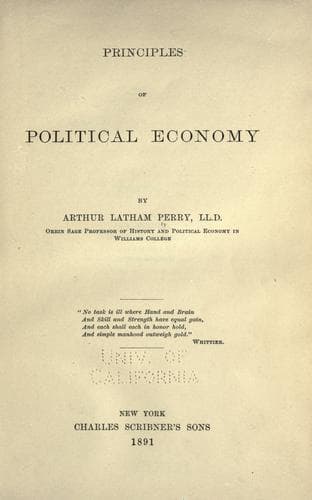
Principles of Political EconomyPerry, Arthur Latham
General
Principles of Political Economy
Perry, Arthur Latham
Economics
These definitions exclude from our circle of view all Efforts of
anybody put forth for other than commercial reasons; and they include
all Efforts of everybody, from the President to the scrub, put forth
under the inducement of a return-service or Wages. No good end seems
to be reached by trying to distinguish, as Francis Walker does in his
"Wages-Question," between the "Wages-class" and the "Salary-class,"
because there appears to be no scientific or other economical
difference between Wages and Salary. Each is a return-service for
another service rendered, and that is all there is to it. The whole
class of Laborers, accordingly, in any civilized and progressive
country, is immensely large and becoming constantly larger. Excluding,
of course, from this class all persons in so far as they render
so-called moral services to others, which are in their very nature
_free_, such as those that spring from duty and courtesy and
benevolence, and these happily are also an immense and fast-augmenting
class, though our Science has nothing to do with them directly, the
number of those persons in every community and in every rank of every
community, who sell personal services of some sort in distinction
from commodities and credits, is pretty nearly as large as the _per
capita_ population of adults and competents within that circuit. It
must be borne in mind, that the same persons whose primary business it
may be to sell commodities or credits, often sell services also in
some subordinate or incidental way; and also, that the same persons,
who are dispensing on the one hand their gifts and moral renderings
freely, are frequently of the busiest in selling on the other hand
their personal services for pay. In other words, the sellers of
Services cannot be discriminated _as to their persons_ from other
sellers, or even from downright _givers_; but the _action_ itself, and
the law of it, is quite distinct in the three cases of selling, and
utterly diverse in the one case of giving.
Public-domain text, read in full here on John Shaqi.
Reviews
Reviews
No reviews yet
Be the first to share your thoughts on this work.
Elsewhere in the archive
Join the Discussion
Join the discussion
Sign in to leave a comment or review.
Sign InorCreate an account