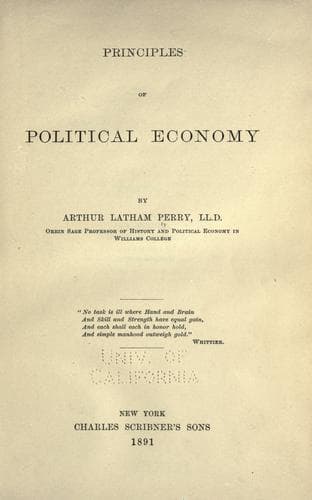
Principles of Political EconomyPerry, Arthur Latham
General
Principles of Political Economy
Perry, Arthur Latham
Economics
Precisely what is rendered, then, in all cases of Personal Services in
each of their three loose kinds, is _muscular motion conjoined with
mental effort and both these assisted by habit and by some form of
what we call Capital_. The Services are therefore _Personal_ in the
highest sense. The Mind and Body of the Laborer conspire to render
them. The most sagacious animal can never be trained to render one of
them. They are wholly _human_. Nevertheless the muscular part in the
rendering--motion and resistance to motion--is just what tools and
machinery can be made to take the place of in large measure but never
in whole measure, because tools may not be taught _to think_. It may
seem sometimes as if machinery were about to take the place of human
hands in some classes of Production; but it will be found in the
ultimate issue, as it has been found in every stage of the process,
that human hands and human minds in action are absolutely essential at
every point of the Exchanges among men. Men are so made and Society is
so organized, that they need increasingly for their comfort and
progress the personal services of their fellow-men, and can render
their own in exchange for these; and consequently, there never can
fail (under freedom) a MARKET for Personal Services of the three
kinds.
Having now seen as closely as possible what that is which is rendered
in personal services, let us pass to the principles which determine
their remuneration. That is, we will now inquire carefully into the
Value of personal services. We have learned already, that Demand and
Supply in their action and reaction upon each other determine in all
cases the value of Commodities for the time being; and we shall find
it to be equally the dictate of all reason, and the outcome of all
experience, that Demand and Supply decide too in all cases on the
value of all Services and all Credits then and there. Shall we look
first at the considerations that issue in the Demand for personal
services, and then at those other considerations that limit the Supply
of them?
1. Demand is never the mere desire for anything, but desire coupled
with the ability to pay for it at rates satisfactory to the present
holder. The Demand for Services, therefore, is made by the prospective
purchasers of them; and the purchasers, of course, are those who
desire them and are willing to pay for them at current rates. It will
be easiest and surest for us to study the Demand for Services in each
of the three classes of them in succession.
Public-domain text, read in full here on John Shaqi.
Reviews
Reviews
No reviews yet
Be the first to share your thoughts on this work.
Elsewhere in the archive
Join the Discussion
Join the discussion
Sign in to leave a comment or review.
Sign InorCreate an account