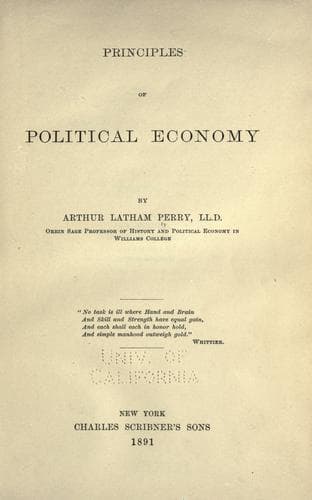
Principles of Political EconomyPerry, Arthur Latham
General
Principles of Political Economy
Perry, Arthur Latham
Economics
the road to excellence be open to all, and no artificial obstructions
thrown in the way of any, there is no blame but rather praise for him
who distances all competitors, and asks and receives for services of
peculiar excellence a large remuneration. Exchange rejoices in all
diversities of advantage that are the birth of freedom, but reprobates
with all her force advantage that is gained by artificial
restrictions, because artificial restrictions always infringe on
somebody's right to render services for a return; and the right to
render services for a return is the fundamental conception in the
Right of Property.
Is it open for us, to gain a somewhat deeper and clearer sense of
_what that is exactly_ that is rendered in these three classes of
personal Services, before we pass to the considerations which
determine in all cases their Value? It is plain, that what common
Laborers sell for the most part, if not exclusively, is _muscular
exertion_ of some kind, guided by the mind as trained in habit, and
aided by appropriate implements, all designed to meet the desire and
so call forth the return-service of the purchaser; it is equally
plain, that skilled Laborers with scarcely any more exceptions than
before sell the same sort of physical exertions, or motions, this time
guided by mental action of a higher grade and wider scope, and aided
also by more elaborate tools working towards the desires and
consequent returns of a set of buyers more scrupulous and exacting
than the first set; and it is plain enough, that some of the highest
professional services, for instance the surgeon's, though not by any
means the mass of such services, are essentially of the same kind as
the two former, namely, muscular motions, guided by the most intimate
and exact knowledge of things, and aided too by instruments the most
scientific and expensive. In many of the professional services the
physical element sinks to a minimum, while the intellectual and moral
factors come to the front and take up the chief attention; it will be
found, however, that the physical factor is always present in some
degree, as, for example, in the counsel's plea before the court, and
in the physician's visit on his patient; and in almost all cases, if
not in all, some implement or other plays its part in the process of
professional service before it ends, as Cicero used a pitch-pipe or
tuning-fork to gauge his voice in his great pleas for Roman clients.
Public-domain text, read in full here on John Shaqi.
Reviews
Reviews
No reviews yet
Be the first to share your thoughts on this work.
Elsewhere in the archive
Join the Discussion
Join the discussion
Sign in to leave a comment or review.
Sign InorCreate an account