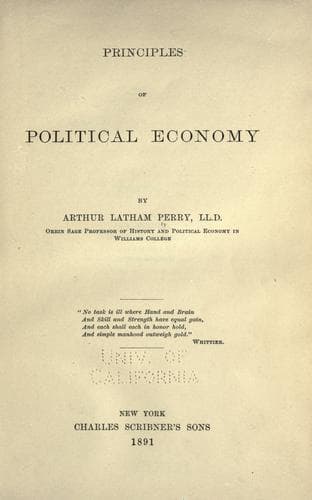
Principles of Political EconomyPerry, Arthur Latham
General
Principles of Political Economy
Perry, Arthur Latham
Economics
But still it is not altogether true, what has sometimes been stated by
economists, that capitalists are under the same sort of pressure to
buy their services as the laborers are to sell them. Capital is a
Valuable already created by the mutual desires and efforts of two
persons, and is now the exclusive property of one of them, and has
also been set apart by him through an act of will to be thereafter an
aid to some future production under the motive of a new value to
accrue thereby. The capital has now become secondary to and separated
from the person who owns it. He very seldom understands the real
nature and operation of it. He commonly imparts to it in his
imagination a more substantive and persistent existence than it
actually possesses. He is frequently more or less stuck up as towards
his neighbors and employees in consequence of his possession of it.
The very fact that he has capitalized it for future operations shows
that he is independent of it as a means of present livelihood. The
personal services of the laborers, on the other hand, stand in very
different relations to _them_. Their personal services may indeed be
_valuable_, but they cannot be _capitalized_. As laborers they have
nothing else to sell. Unless they sell their services now, these have
no existence even, still less can they have any value. It is only by a
mischievous figure of speech, that the skill of laborers is sometimes
spoken of as their "Capital." Therefore, the laborers are under a
certain remote yet inherent disadvantage as sellers of their personal
services, when compared with the capitalists as buyers of them. This
disadvantage, however, though apparent in the nature of things, and
under certain circumstances disastrous to the laborers, may disappear
practically under another and natural state of things; and it is every
way to be desired by both classes alike that it should disappear in
practice.
Whenever there is a broad and constant and profitable market for all
the commodities the capitalists and the laborers can jointly
produce,--that is to say, whenever profits are steady and remunerative
and wages are high and growing in their purchasing-power,--the Demand
for skilled laborers must always be such as puts the laborers on a
footing of equality as over against the capitalists, because under
such circumstances the purchasers of services are many and eager, two
bosses will be likely to be bidding for one skilled laborer, and then
wages are always growing in dollars and each dollar growing in
effective purchasing-power.
Public-domain text, read in full here on John Shaqi.
Reviews
Reviews
No reviews yet
Be the first to share your thoughts on this work.
Elsewhere in the archive
Join the Discussion
Join the discussion
Sign in to leave a comment or review.
Sign InorCreate an account