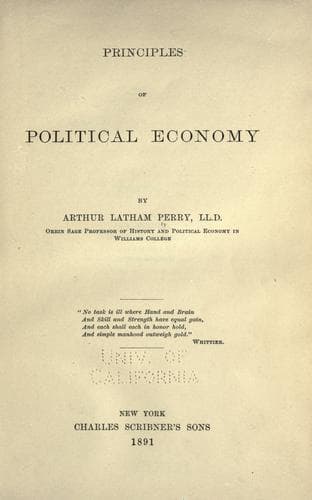
Principles of Political EconomyPerry, Arthur Latham
General
Principles of Political Economy
Perry, Arthur Latham
Economics
It is of the last importance in this connection to notice, that
everything in Profits and Wages turns in the last resort upon the
breadth and freedom of MARKETS. It is out of the return-service
received from the _sale_ of the commodities produced jointly by the
capitalists and laborers, that both wages and profits must ultimately
be paid. There is no other possible source of them. When the Market
fails, everything fails that leads up to a market. Particularly fails
the Demand for laborers for the next industrial cycle, and of course
drops also the prospective wages for that cycle. The public folly and
universal loss of shutting off foreign markets for our own commodities
by lofty tariff-barriers, as has been conspicuously done by the United
States for thirty years past, follows of course from this radical
truth; and the Wages of laborers, instead of being lifted by
tariff-taxes, as has been so often falsely and wickedly asserted, are
inevitably _depressed_ by them, because they effectually forbid to
capitalists and laborers their best and freely chosen _markets_ for
the sale of their joint products.
Another vastly important matter, constantly affecting the Demand for
laborers of the second class, is the Competency or otherwise of the
practical managers of the Capital invested in industrial enterprises.
Capital cannot manage itself. It is of itself wholly inert. It is
always either a Commodity or a Credit. Conscious of their inability to
handle wisely their own bits of Capital, or else taught it through a
bitter experience, by far the larger number of individual owners of it
loan it to others to manage; they invest it in some industrial
corporation, in a bank or a mill or a railroad. Some one person, or at
least a small body of persons, must practically manage now all
specific accumulations of capital. It is they in their capacity of
manipulating-capitalists, who constitute in large measure the Demand
for laborers. But such managers, who are at once skilful and
long-headed and honest, do not grow upon a chance bush. They are rare.
Most of them in this country at least have been those, who started in
a small way in the control of their own earned or small-inherited
properties, and rose through practice and knowledge and conscience to
the ability to handle profitably to all concerned large masses of
Capital. In the hands of such men, given a tolerable chance by public
law and private circumstances, both Profits and Wages are sure to come
in satisfactorily. They are Captains of Industry. They are an honor to
human nature. They are a blessing to the whole community. They have no
need and no will to ask to be bolstered up in their business by unjust
taxes enforced upon a whole people.
Public-domain text, read in full here on John Shaqi.
Reviews
Reviews
No reviews yet
Be the first to share your thoughts on this work.
Elsewhere in the archive
Join the Discussion
Join the discussion
Sign in to leave a comment or review.
Sign InorCreate an account