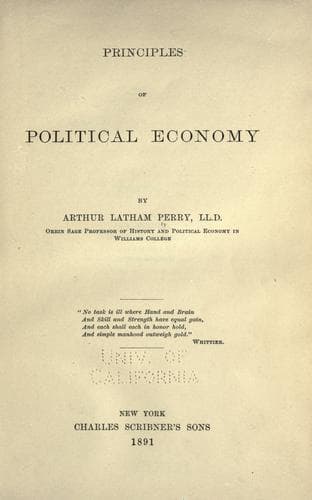
Principles of Political EconomyPerry, Arthur Latham
General
Principles of Political Economy
Perry, Arthur Latham
Economics
(c) The more commodities thus created by men and machines, and the
wider the markets found for them over the earth, the more laborers are
required to extract and prepare and transport the raw materials for
the now augmenting commodities, and also to ship and distribute the
finished products. As Chadwick says, notwithstanding the strictly
_factory_ hands have diminished one half in one place, "yet the _mill_
population has increased, as well as the general population, the hands
discharged being absorbed in other employments."
(d) These improvements in machinery, and the consequent refinements in
the skill of the laborers, cheapen also of course the commodities
consumed by the laborers themselves, and therefore a given rate of
wages, to say nothing of a rate sure to enlarge under these
circumstances, now secures for the laborers a higher grade of
comforts.
More and better and more durable machinery, consequently, so far
forth, tends at once to enhance the rate of laborers' wages and
increase the purchasing power of the unit in which wages are paid.
To return now to the main line of discussion under the present head,
we have shown by proof positive that there is nothing either in new
machinery introduced, or in higher wages paid in connection with such
machinery, or in shortened hours made possible by these two, to lessen
the Demand of Capitalists for the personal services of Laborers;
because, there is nothing in all these, commercial and industrial
freedom being presupposed, to lessen the Profits of the Capitalists,
which profits are the sole motive actuating them as such. That high
wages and short hours are rather an advantage to Profits in connection
with skilled laborers and fine machinery, than a disadvantage when
compared with long hours and low pay and poor implements, is clearly
shown by Chadwick in the passage quoted comparing England with English
Bombay, where the working hours are 60% more and the wages greatly
less and the cost of the machinery very little; "twenty shillings'
worth of bundled yarn may be produced at a cost of from 2_d._ to 3_d._
less in Manchester than in Bombay"; call it 2-1/2_d._ less; that is,
it costs the Bombay spinner more than 1% per pound of yarn more to
spin it than it costs the Manchester spinner! For truth and decency's
sake, then, let us have done with the gabble in this country about the
advantages of "pauper labor" over skilled, of low wages over high, of
cheap machinery over dear!
Public-domain text, read in full here on John Shaqi.
Reviews
Reviews
No reviews yet
Be the first to share your thoughts on this work.
Elsewhere in the archive
Join the Discussion
Join the discussion
Sign in to leave a comment or review.
Sign InorCreate an account