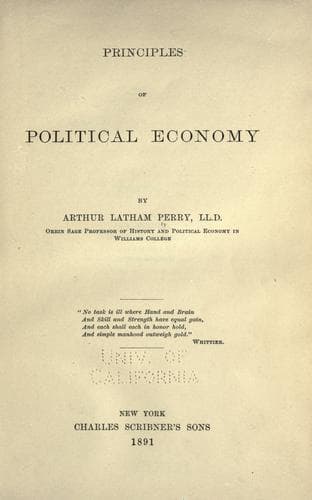
Principles of Political EconomyPerry, Arthur Latham
General
Principles of Political Economy
Perry, Arthur Latham
Economics
The accuracy of these important statements of fact is confirmed on
every hand. Committees of British spinners and weavers have repeatedly
visited the United States, and then reported to their fellows at home,
that wages, all things considered, were equal for spinners and weavers
in Great Britain and the United States, and in some cases and respects
higher in the former. Many times before his late lamented death,
John Bright publicly testified that wages in England during his
parliamentary life had risen in general 50%, and in some of the
manufacturing lines 100%. A few months before these statements of
Chadwick were made, Sir Richard Temple reported to his section of the
British Association, "_That the average earnings per head in the United
Kingdom, taking the whole population without division into classes, is
£35, 4s., and exceeds the average of the United States, which is £27,
4s., and of Canada, which is £26, 18s., and of the Continent, which is
£18, 1s.; while it falls below that of Australia, which is £43, 4s. per
head._"
According to this, the average earnings in Great Britain per head of
the population are 30% higher than in the United States, and 81%
higher than on the Continent of Europe. Truly, Britain is a prosperous
and profitable country so far as average earnings of the whole people
by the year is concerned. Sir Richard goes on in the same statistical
paper to show, that the average annual profit on British Capital is
14%, and that Capital yields about the same rate for the United
States.
Now, can we easily give the grounds on which the introduction of more
and better machinery, instead of displacing laborers, tends to lift
and actually does lift the wages of those concerned, who continue to
work with their hands and heads? We will try it.
(a) It takes the hands and heads of laborers to invent and construct
and keep in repair the machinery itself, that is often supposed to
displace laborers, and so far forth opens a vent for the more
profitable employment of some of the laborers, who before performed
the cruder and more repetitive and automatic parts of the processes,
which parts alone machinery can be made to perform.
(b) Machinery always lessens the cost of a given amount of production,
otherwise there would be no motive for its introduction. But, other
things being equal, the lessened cost of a commodity broadens the
market for its sale. The cheaper a useful commodity is offered, the
more the buyers of it the world over. The more and the better the
machinery brought in, the more and the cheaper the commodities
produced and the broader and better the markets to be supplied; and,
therefore, the more and the more skilful the hands needed to tend the
machinery and to market the products.
Public-domain text, read in full here on John Shaqi.
Reviews
Reviews
No reviews yet
Be the first to share your thoughts on this work.
Elsewhere in the archive
Join the Discussion
Join the discussion
Sign in to leave a comment or review.
Sign InorCreate an account