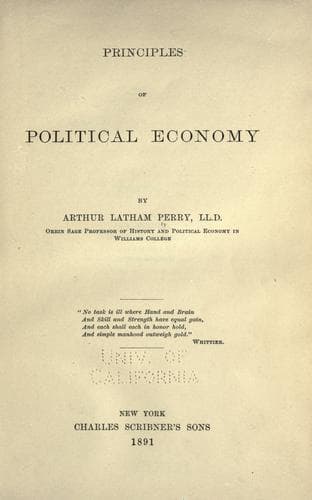
Principles of Political EconomyPerry, Arthur Latham
General
Principles of Political Economy
Perry, Arthur Latham
Economics
(c) The grounds for the unabating Demand in Christian countries for
religious teachers and preachers, let us rather say, for spiritual
guides, lie deep down in the nature of man. If there be one
proposition about men more incontestable than another, it may be this,
that men are made in the image of God, and that there is among men in
general an irrepressible striving to maintain and deepen this image.
The touch between man and man and between man and God is such at this
point, that men can help each other in this striving, and that they
_feel_ that they can help each other. This is the chief reason why
some men are constantly consecrating themselves to the Christian
ministry, and other men as constantly soliciting these to become their
pastors and teachers. Those more enlightened in divine things and more
spiritually minded offer themselves, as it were, not commercially but
morally, to the unenlightened and less advanced as guides and helpers.
It is, as it was with Wolfe and his men at the Heights of Abraham:
those who got first to the top tarried a little to help those up who
came after. And the most striking thing about it is, that the masses
of men at bottom are as desirous to be uplifted as the choicer spirits
among them are desirous to help the work forward. Ministers are still,
and always will be (human nature is unchangeable), eagerly called;
chapels and churches and cathedrals are still going up all over the
earth; worship and petition and aspiration are ever ascending on the
great world's altar stairs towards heaven, guided and inflamed by the
chosen and choosing men of God,--"_when priests on grand cathedral
altars praise_!"[5]
It is a monstrous perversion of language to maintain, that a clergyman
in rendering such services as these is selling his religion. It is
true, that he is selling under Demand services to the appropriate
rendering of which his own personal piety contributes one large
element, and thorough confidence in him on the part of his people as a
good and earnest man contributes another large element; but the piety
and the spiritual power and the worthy example are not nourished for
the sake of selling the services, but for their own sake in personal
worth and worthiness, and these things must not be confounded with the
services that are sold. Accordingly, while the clergyman's vocation is
sacred, and belongs to the sphere of religion, his salary belongs to
the sphere of exchange, and its determination, in harmony of course
with the higher impulses, is a business transaction. This distinction
ought to be better understood than it is; and both clergymen and
people need to be reminded that the spiritual things belong to one
sphere, and the temporal things to another. The amount of a minister's
salary, and the time and mode of its payment, are matters of pure
business; and the minister himself is to be blamed if he does not
attend to them, and insist on them, on business principles.
Public-domain text, read in full here on John Shaqi.
Reviews
Reviews
No reviews yet
Be the first to share your thoughts on this work.
Elsewhere in the archive
Join the Discussion
Join the discussion
Sign in to leave a comment or review.
Sign InorCreate an account