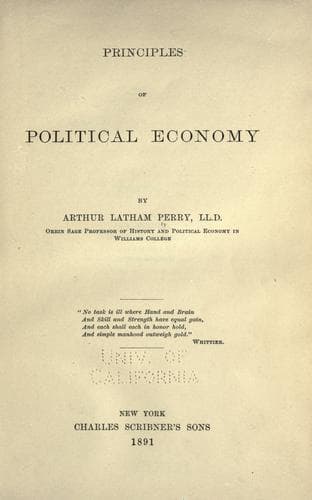
Principles of Political EconomyPerry, Arthur Latham
General
Principles of Political Economy
Perry, Arthur Latham
Economics
In the professions generally, and particularly in the ministerial
profession, while, if we confine our attention to those persons who
both have the requisite gifts of Nature and have been also thoroughly
trained, we shall find a high rate of compensation on the two grounds
of a strong Demand and a limited Supply, we must bear in mind too the
counter-working influences which tend to increase the competition and
thus decrease the compensation, namely, the respectability which
attends them, the desire of knowledge for its own sake which is gained
in connection with them, the instruction wholly or in part
gratuitously offered to those in course of preparation for them, and
the desire to do good without regard to pecuniary reward which
actuates many who enter upon them.
(d) Physicians and lawyers and clergymen serve primarily individuals,
or at most relatively small groups of individuals, and of course look
for their pay to those whom they have served. It is different with
Statesmen, the fourth class of professional laborers that we need to
look at in an economic view. Statesmen worthy of the name serve at
least a whole nation, and to the nation as such must they turn for
their pecuniary rewards. And such men have never turned in vain to
those whom they have benefited as a whole. Bismarck is the best modern
instance of a Statesman, who has received from a grateful country
immense money-measured remunerations for immense political services
rendered. The Demand for the services of Statesmen rests in the deep
consciousness of men organized politically into a Nation, that they
need, especially in trying times, a Man of the highest natural gifts,
and of the broadest attainments and of the loftiest political
integrity to plan and act for them in emergencies, as they are
conscious that they cannot plan and act for themselves organically.
This does not mean, that the one ever knows essentials better than the
many: he does not. This does not mean, that the true objective of a
nation's march is ever discerned more clearly, or rather _felt after_
more eagerly, by one man than by the many men concerned: it is not.
Still less does it mean "_a man on horseback_." But it does mean this:
a Nation (as the very name implies) is made up of the thoughts and
hopes and throbbings and dim forecastings and half-formed purposes of
multitudes constituting a unit (born together for one destiny on
earth); and the true Statesman is one of themselves, sharing with them
at once the traditions of the past and the perspectives of the future;
one, with the instinct and the intellect to gather up and embody the
general feeling and the general will; one, who has gained in some way
the confidence of the masses who are willing for the time being to
entrust to him the guidance of their affairs, and to empower him to
plan and act for them as their champion and deliverer; and one, who
(because he _is_ one) can better seize the propitious moments for
Public-domain text, read in full here on John Shaqi.
Reviews
Reviews
No reviews yet
Be the first to share your thoughts on this work.
Elsewhere in the archive
Join the Discussion
Join the discussion
Sign in to leave a comment or review.
Sign InorCreate an account