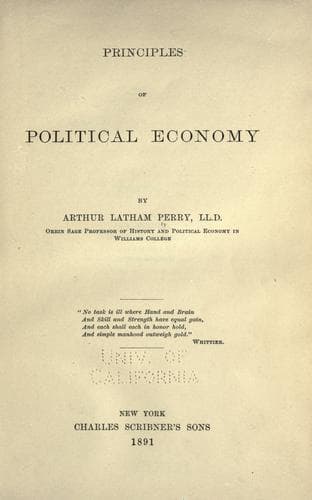
Principles of Political EconomyPerry, Arthur Latham
General
Principles of Political Economy
Perry, Arthur Latham
Economics
(f) _Custom_, with its cognates Prejudice and Fashion, has still a
good deal to do with the Supply of laborers in certain departments of
effort, and of course with the rates of wages in them. In former times
in this country and in the older countries particularly, Custom and
decree were dominant in determining, for example, the current fees of
lawyers and doctors, competition coming in to decide how many such
fees a professional laborer should get, rather than the amount of each
particular fee. The shares of the produce going respectively to the
agricultural tenant and to the landowner, were specially under the
dominion of Custom; as the mode (now decadent) of taking farms "_at
the halves_," once universally prevalent in New England, sufficiently
shows. In certain other matters relating to land and trade, Custom has
long been gradually hardening into express law, as, for instance, the
famous "Ulster Right" in Ireland. Prejudice, which is only another
name for Custom, has some voice still in adjusting rates of wages, as
may be seen in women's wages crowded down apparently to a point
unreasonably low as compared with the wages of men; and also in the
rate of John Chinaman's wages in those parts of the United States
where he ventures to offer his services in the teeth of public opinion
and hostile legislation. It may be spoken with general truth and
satisfaction, that competition seems now to be breaking down mere
custom and prejudice in all directions, and may perhaps in the good
time coming reign supreme over the economic field; while Fashion,
which bears indeed on one side of its shield the motto "custom,"
carries too on the other the bold word "competition," and this second
side is likely to be presented to the public mostly in the future,
because, they who lead the styles in any department whatsoever will
always offer their services to Society at an advantage to themselves,
that being one form of competition, and their rate of compensation
will be legitimately higher than the average rate of their fellows, of
which a good instance was the marked worldly prosperity during the
decade of the Eighties of Worth, the man-dressmaker of Paris.
Public-domain text, read in full here on John Shaqi.
Reviews
Reviews
No reviews yet
Be the first to share your thoughts on this work.
Elsewhere in the archive
Join the Discussion
Join the discussion
Sign in to leave a comment or review.
Sign InorCreate an account