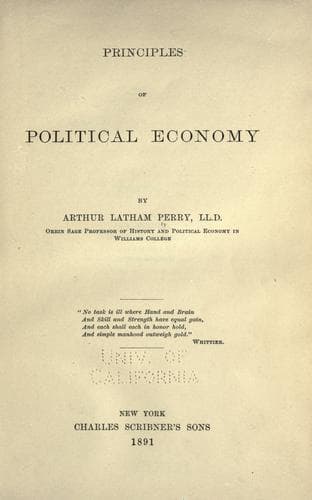
Principles of Political EconomyPerry, Arthur Latham
General
Principles of Political Economy
Perry, Arthur Latham
Economics
(g) _Legal Restrictions_ are another cause acting on wages, by acting
directly on the Supply of laborers. Laws inhibiting or promoting
immigration; laws appointing the fees and salaries of officials;
tariff-taxes, whether prohibitory or only restrictive; laws creating
privileged classes of any kind, which is only another designation for
laws restricting the rights of the masses; unequal modes of taxation,
whether adopted in ignorance or by design; all have a direct and
powerful agency upon the distribution of laborers, upon the supply of
them at given points, and upon the rates of their wages. Governments
are coming, however, much more freely than formerly, but never through
their natural choice and drift as governments, only by the gradual and
oft-disappointed compulsion of their citizens, to leave all these
matters Economical except the wages of their own servants and those
commodities which they choose to tax, to the simple and safe action of
Supply and Demand.
(h) _Voluntary Associations_ for that avowed purpose were a mediæval,
and have come to be again a modern, agency in adjusting the Supply of
laborers to their respective markets, and in regulating the wages of
various classes of them. The Guilds of the Middle Ages, and
particularly the old guilds of London, had a remarkable history, upon
which we can not here even touch. Their local importance is
sufficiently attested by the fact, that the City Hall of London is to
this day the "Guildhall." King Edward III. humored the civic feeling
of his time by becoming himself a member of the Guild of Armorers. "A
seven years' apprenticeship formed the necessary prelude to full
membership of any trade-guild. Their regulations were of the minutest
character; the quality and value of work was rigidly prescribed, the
hours of toil fixed from daybreak to curfew, and strict provision made
against competition in labor. At each meeting of these guilds their
members gathered round the Craft-box, which contained the rules of
their Society, and stood with bared heads as it was opened. The warden
and a quorum of guild-brothers formed a court which enforced the
ordinances of the guild, inspected all work done by its members,
confiscated unlawful tools or unworthy goods; and disobedience to
their orders was punished by fines, or in the last resort by
expulsion, which involved the loss of right to trade. A common fund
was raised by contributions among the members, which not only provided
for the trade objects of the guild, but sufficed to found chantries
and masses, and set up painted windows in the church of their patron
saint. Even at the present day the arms of the craft-guild may often
be seen blazoned in cathedrals, side by side with those of prelates
and kings."[6]
Public-domain text, read in full here on John Shaqi.
Reviews
Reviews
No reviews yet
Be the first to share your thoughts on this work.
Elsewhere in the archive
Join the Discussion
Join the discussion
Sign in to leave a comment or review.
Sign InorCreate an account