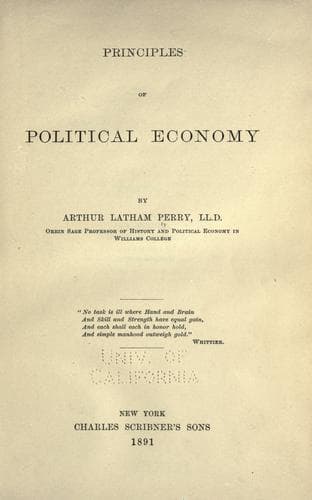
Principles of Political EconomyPerry, Arthur Latham
General
Principles of Political Economy
Perry, Arthur Latham
Economics
John Ball's famous rhyme condensed the scorn for the
nobles, the longing for just rule, and the resentment at oppression,
of the peasants of that time and of all times:--
"When Adam delved and Eve span,
Who was then the gentleman?"
A hundred years after the Black Death the wages of a common English
laborer--we have the highest authority for the statement--commanded
twice the amount of the necessaries of life which could have been
obtained for the wages paid under Edward III.
3. Having now seen fully the varied action of Supply and Demand upon
the Value of personal services in their three kinds, we come at length
to the most important general point in this chapter, namely, that in
the second class of Services, those purchased in connection with the
use of _Capital_, WAGES ARE ALL THE TIME ENLARGING RELATIVELY TO
PROFITS. We have seen clearly already, that Cost of Labor and Cost of
Capital are the only onerous elements in the cost of Commodities;
because, while Natural Agents are all the time assisting and assisting
more and more effectively in such production, they work without
weariness or decay and without fee or reward. The reward of laborers
is Wages, and the reward of capitalists is Profits; and we are now to
demonstrate, that the part of their joint products falling to laborers
as wages is all the while increasing as compared with the remaining
part falling to capitalists as profits. This truth is of the deepest
significance, and of the most cheering character; because men are more
important in the universe than things; and because the number of men
who sell their services as laborers is vastly greater than the number
of men who sell their services as capitalists.
It is another indisputable and exhilarating truth for the masses of
mankind, that the Value of each item or article of those products
created by the joint action of laborers and capitalists is ever
becoming less and less as measured by any relatively fixed standard as
Money; so that, while wages as thus measured becomes a larger and
larger aggregate as compared with the aggregate of profits, and is
shared of course by a much larger number of people, those commodities
looked at as a collection of items for which the wages of these many
is usually expended for their own comforts, are becoming all the time
cheaper and cheaper to everybody, owing to the ever-enlarging and
wholly gratuitous action of natural forces.
Public-domain text, read in full here on John Shaqi.
Reviews
Reviews
No reviews yet
Be the first to share your thoughts on this work.
Elsewhere in the archive
Join the Discussion
Join the discussion
Sign in to leave a comment or review.
Sign InorCreate an account