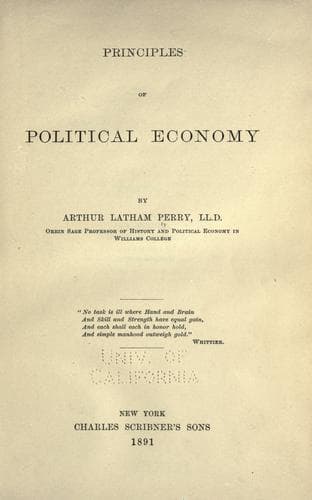
Principles of Political EconomyPerry, Arthur Latham
General
Principles of Political Economy
Perry, Arthur Latham
Economics
The Trades-Unions and Brotherhoods of the present day cannot plead the
provocations and justifications of their mediæval predecessors. It
cannot be denied, however, that they have some provocations and
justifications in the bad example set before them by the various
combinations (implied or explicit) of the Wages-payers as a class. If
the Wages-payers combine, then the Wages-takers would seem to have no
resource but in combination. Both alike are wrong in this. Both alike
oppose in this the spirit of Political Economy, which is ever the
spirit of Freedom, and is ever against such factitious associations
for such purposes, because they tend to destroy the independence of
personal action on the part of both payers and takers of wages, and
tend also to bring all the workmen of any one general grade down to
one level of effort and reward.
(i) Lastly, we must note the influence of _Casual Events_ upon wages,
as these events affect the Supply of laborers. For example, in 1348, a
terrible plague, called the Black Death, invaded England and swept
away more than one-half of its population. "Even when the first burst
of panic was over, the sudden rise of wages consequent on the enormous
diminution in the supply of free labor, though accompanied by a
corresponding rise in the price of food, rudely disturbed the course
of industrial employments; harvests rotted on the ground, and fields
were left untilled, not merely from scarcity of hands, but from the
strife which now for the first time revealed itself between Capital
and Labor" (Green). The landowners of the country districts, and the
craftsmen of the towns, not understanding the law of Wages as an
invariable resultant of the Demand and Supply of laborers, were
scandalized by what seemed to them the extravagant demands of the new
labor-class. Parliament equally ignorant with the People of the
natural economic law, enacted as follows: "_Every man or woman of
whatsoever condition, free or bond, able in body, and within the age
of threescore years, and not having of his own whereof he may live,
nor land of his own about the tillage of which he may occupy himself,
and not serving any other, shall be bound to serve the employer who
shall require him to do so, and shall take only the wages which were
accustomed to be taken in the neighborhood where he is bound to serve
two years before the plague began._" Afterwards, the runaway laborer
was ordered by Parliamentary enactment to be branded in the forehead
by a hot iron, and the harboring of the country serfs in the towns, in
which under their civic rules a serf keeping himself a year and a day
was thereafter free, was rigorously forbidden. These acts of
Parliament, and many more of the same kind, were powerless to keep
down wages to the old standard, but were powerful to keep up ill-blood
and social discontent. They prepared the way for agitators like John
Ball, for the poet-agitator Piers Ploughman, and for the great Peasant
Revolt of 1381.
Public-domain text, read in full here on John Shaqi.
Reviews
Reviews
No reviews yet
Be the first to share your thoughts on this work.
Elsewhere in the archive
Join the Discussion
Join the discussion
Sign in to leave a comment or review.
Sign InorCreate an account