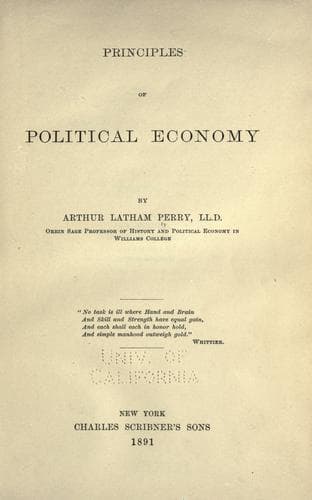
Principles of Political EconomyPerry, Arthur Latham
General
Principles of Political Economy
Perry, Arthur Latham
Economics
(b) _There were two desires_, Solomon's desire for cedar-timbers to
build the temple with, and Hiram's desire for wheat and oil with which
to support the people of his sterile kingdom. "_So Hiram gave Solomon
cedar-trees and fir-trees according to all his desire: and Solomon
gave Hiram twenty thousand measures of wheat for food to his
household, and twenty measures of pure oil._" The desire of each
party was personal and peculiar, known at first only to himself, but
upon occasion became directed towards something in the possession of
the other, and each at length became aware of the desire of the other,
and also of his own ability to satisfy the want of the other. If
Solomon could have satisfied his desire for timber by his own or his
subjects' efforts directly, this trade would never have taken place;
if Hiram or his subjects could have gotten the wheat and oil directly
out of their narrow and sandy strips of sea-coast, this trade would
not have taken place; and so there must be in every case of trade not
only two desires each springing from a separate person, but also each
person must have in his possession something fitted to gratify the
desire of the other person, and each be willing to yield that
something into the possession of the other for the sake of receiving
from him that which will satisfy his own desire, and so both desires
be satisfied indirectly.
Here is the deep and perennial source of exchanges. Men's desires are
so many and various, and so constantly becoming more numerous and
miscellaneous, and so extremely few of his own wants can ever be met
by any one man directly, that the foundation of exchanges, and of a
perpetually increasing volume of exchanges, is laid in the deep places
of human hearts, namely, in Desires ever welling up to the surface and
demanding their satisfaction through an easy and natural interaction
with the ever swelling Desires of other men. Here too is a firm
foundation (a chief foundation) of human Society. Reciprocal wants,
which can only be met through exchanges, draw men together locally and
bind them together socially, in hamlets and towns and cities and
States and Nations, and also knit ties scarcely less strong and
beneficent between the separate and remotest nationalities of the
earth. It is certain that an inland commercial route connected the
East of Asia with the West of Europe centuries before Christ, and that
a traffic was maintained on the frontier of China between the Sina and
the Scythians, in the manner still followed by the Chinese and the
Russians at _Kiachta_. The Sina had an independent position in Western
China as early as the eighth century before Christ, and five centuries
later established their sway under the dynasty of Tsin (whence our
word "China") over the whole of the empire. The prophet Isaiah
exclaims (xlix, 12), "Behold! these shall come from far; and behold!
these from the North and from the West; _and these from the land of
Public-domain text, read in full here on John Shaqi.
Reviews
Reviews
No reviews yet
Be the first to share your thoughts on this work.
Join the Discussion
Join the discussion
Sign in to leave a comment or review.
Sign InorCreate an account