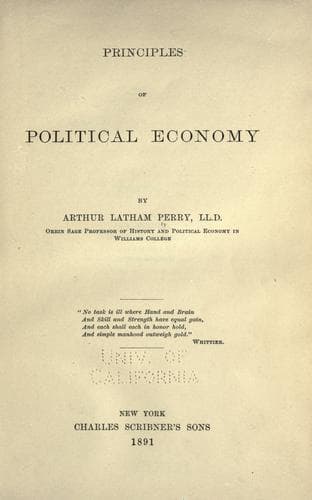
Principles of Political EconomyPerry, Arthur Latham
General
Principles of Political Economy
Perry, Arthur Latham
Economics
In 1867 the engineers and firemen received 20-865/1000 per cent. of
total cost.
In 1886 the engineers and firemen received 39-627/1000 per cent. of
total cost.
These illustrations from the railroads are plainly indicative of a
general truth of the utmost importance in Political Economy, namely,
_that all increase of Capital and all inventions and improvements in
its practical application, while it redounds to the benefit of
capitalists as a class, redounds in a still higher degree to the
benefit of laborers as a class_. Let us now attend for a moment to the
convincing Proof of this truth in two phases of such proof, and also
to a cheering conclusion that follows it.
(a) As any country grows older in time and richer through abstinence,
and as the whole world thus grows older and richer, the tendency
there and everywhere towards a general decline in the rate _per
centum_ for the use of capital becomes patent and universal. The rate
of interest on money loaned, and the rate of profits on capital used,
tend all the while to go down as and because capital accumulates. No
one will dispute this as a simple fact of history. And no economist
will dispute, that this is just what we might expect beforehand as a
corollary from the admitted proposition, that, other things being
equal, an increased Supply of anything means a lessened Value for any
specific part of it. Three centuries ago in England the legal rate of
interest was 10%, while now the current rate is about 4% in that
country, and has been considerably lower than that in Holland,
although in both countries and everywhere else there are temporary
interruptions and reactions in the constant tendency now being
considered. During the first years of mining operations in California,
from 8% to 15% per month with security of real estate was paid for the
use of money, which enormous rates long ago declined to rates not much
higher than those paid in the States along the Mississippi River, and
in these also the rates are all the while approximating those current
in the older Eastern States, whose own rates too are slowly declining.
But, while there is a less rate of profit or interest on each 100
invested, there are many more hundreds capitalized; consequently,
there is an absolute gain to capitalists as a class, at once in the
aggregate amount of the capital and in the aggregate sum of the
profits from it, since no capitalist would have a motive to capitalize
further under the smaller rates of profit, unless the aggregate of
profits under the new conditions were greater than under the old
condition of higher rates; and, as much of this accumulating capital
in order to become productive must now be offered to laborers in the
form of wages, we might almost pronounce beforehand, that it would
prove both an absolute and also a _relative_ gain to laborers as a
class. And so it is.
Public-domain text, read in full here on John Shaqi.
Reviews
Reviews
No reviews yet
Be the first to share your thoughts on this work.
Elsewhere in the archive
Join the Discussion
Join the discussion
Sign in to leave a comment or review.
Sign InorCreate an account