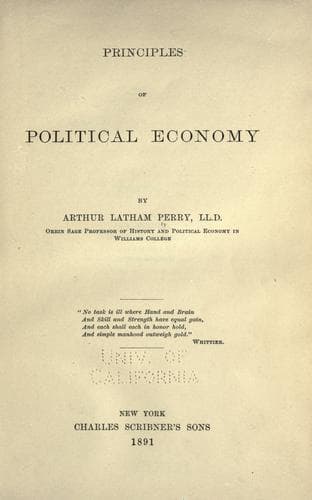
Principles of Political EconomyPerry, Arthur Latham
General
Principles of Political Economy
Perry, Arthur Latham
Economics
(b) Let us take to figures. An hypothesis or supposed case, whenever
it may easily become an overt fact, may be reasoned from just as
logically and securely as the overt fact itself. Let $100,000,000,
while the rate of profit is 6%, and $500,000,000, when the rate has
fallen to 4%, be expended in payment of simple wages. So far forth as
that one element of cost goes, the value of the products to be divided
yearly between capitalists and laborers will become respectively
$106,000,000 and $520,000,000. In the first case, $6,000,000 is
profits and $100,000,000 is wages; in the second case, $20,000,000 is
profits and $500,000,000 is wages. Here is an absolute gain to the
capitalists, since profits have gone up from $6,000,000 to
$20,000,000, and so are more than _three_ times as great as before.
But wages have gone up both absolutely and relatively to the rise of
profits. They have risen from $100,000,000 to $500,000,000, and are
_five_ times as great as before. Profits have risen as in the ratio
1:3+, but wages in the ratio of 1:5. This arithmetical example is put
for the sake of illustration merely, but the principle of it holds
good in every case, in which the rate _per centum_ goes down in
consequence of the increase of capital in business; and, therefore,
the advantages of ever-enlarging Capital are even greater to laborers
as a class than to the capitalists themselves. Most assuredly, if the
capitalists take less out of each hundred of the swelling hundreds now
than before, the laborers must take more out of each hundred than
before. Profits and Wages are reciprocally the _leavings_ of each
other, because the aggregate products created by the joint agency of
Capitalist and Laborer are wholly to be divided between the two. There
can be no other _claimant_ even.
Public-domain text, read in full here on John Shaqi.
Reviews
Reviews
No reviews yet
Be the first to share your thoughts on this work.
Elsewhere in the archive
Join the Discussion
Join the discussion
Sign in to leave a comment or review.
Sign InorCreate an account