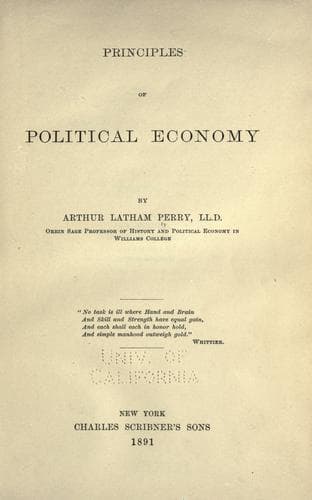
Principles of Political EconomyPerry, Arthur Latham
General
Principles of Political Economy
Perry, Arthur Latham
Economics
A clouded understanding of this vital distinction has always played
its part in Labor-troubles. Buyers and Sellers of personal services
are always on a plane of perfect equality as such exchangers, and no
one can be more independent than either of them except the hermit in
his cell. Which must look out for the interest of the other beyond the
terms implied in the trade itself? Which is the superior party? Which
should take off his hat, the other remaining covered? The truth is,
and all experience and all analysis brings us up abreast of it, that
the two parties to a trade of any kind stand on a footing of absolute
equality towards each other then and there in the economical relation
about to be knit, and any conception in the mind of either that he has
the other "at his mercy" in either the good or bad sense of that
phrase, disturbs and destroys the proper conditions and balances of
the exchange in hand; and, what is more to the point, it implies that
each party has _not_ all he can do to fulfil in the letter and in the
spirit what is always implied in the terms of a trade deliberately
entered upon by two parties. When B agrees to work for A at skilled
labor in his factory for a year at $15 per week, he makes a good deal
of a contract; and virtually pledges to A not only the motions of his
hands for that period of time, but also the vigorous attention of his
mind to that service and to the general interests of his employer so
far as these come under his own eye and supervision. Nor is this all:
he virtually pledges himself to B to coöperate with the least possible
friction in all plans for betterment in his division of the work, and
to cordially coalesce with all other employees for the general ends of
the business without too much of self-assertion and without too little
of courtesy to others. To fulfil this contract in all its spirit
rounds up the circle of B's economical obligations to A. He will
practically have all he can do, so far as A is concerned, and in
consistency with all his various duties to others, to make good to him
at all points his simple business pledges. Benevolence, the interests
of a common citizenship, and the reciprocal ties of religion, lie
wholly outside.
Public-domain text, read in full here on John Shaqi.
Reviews
Reviews
No reviews yet
Be the first to share your thoughts on this work.
Elsewhere in the archive
Join the Discussion
Join the discussion
Sign in to leave a comment or review.
Sign InorCreate an account