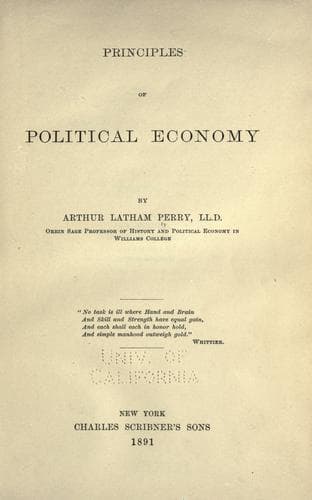
Principles of Political EconomyPerry, Arthur Latham
General
Principles of Political Economy
Perry, Arthur Latham
Economics
(1) There is an extremely common misapprehension on the part of both
labor-givers and labor-takers as to the real _nature_ of the
transaction between them. Both parties forget, or rather neither party
is ever fully instructed, that it is a case of pure Buying and
Selling. There is never any _obligation_ of the moral sort between
buyers and sellers. The relation itself is purely economical. Moral
considerations indeed cover this relation from above, just as they
cover all other relations between man and man in human Society; and
any two individuals standing over against one another as buyer and
seller, also stand over against each other in higher and broader
relations as man and man; but it works confusion and mischief as
between both, whenever relations differing in their nature and
operation and reward are not separated from each other in the mind of
each relator, and whenever each does not act in the particular
relation according to the nature and rules of that relation alone.
When A hires B to work in his factory, this new relation is economical
not moral; there were moral relations between the two before this
relation was knit, and will be again after this has been broken, and
indeed are while this continues; but the economical relation is one
thing, and the others a very different thing; they are so different,
that they cannot be blended in mind or motive to any advantage to
either individual or to either set of relations; and any degree of
confusion as between the relations has always wrought mischief as
between the individuals, because instead of seeing either set of
relations in its own clear light, they now see both in a commingled
twilight.
What is the economical relation? This. A desires the personal service
of B in his factory purely for his pecuniary benefit, and assumes his
own ability to make all the calculations requisite for determining how
much he can (profitably to himself) offer B for his service; and B,
who knows all about his own skill, how it was acquired and how much it
has cost, wants to sell his service to A for the sake of the pecuniary
return or wages. There is no obligation resting upon either. Man to
man, each in his own right. There is no benevolence in the heart of
either, so far as this matter goes. Benevolence is now an
impertinence. It is a question of honest gain in broad daylight.
Benevolence is blessed in its own sphere, but there is no call for it
here and now. If it comes in an unbidden guest, it comes in to mar and
to distort. It is an incongruity. "_I never knew a Jew converted but
it spoilt him_," was the word of one deeply versed in human nature and
in Christian experience. Conversion is good, and its field is broad;
but the Jew _as such_ is incongruous with it. Good is benevolence and
wide its field, but Buying and Selling does not need it. Its own
motives are independent of it, and sufficient without it.
Public-domain text, read in full here on John Shaqi.
Reviews
Reviews
No reviews yet
Be the first to share your thoughts on this work.
Elsewhere in the archive
Join the Discussion
Join the discussion
Sign in to leave a comment or review.
Sign InorCreate an account