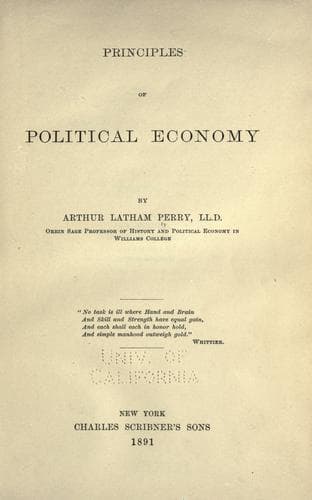
Principles of Political EconomyPerry, Arthur Latham
General
Principles of Political Economy
Perry, Arthur Latham
Economics
(b) The practical remedy for the inexperience and instability and
unskilfulness of laborers as tending towards labor-troubles of all
kinds and degrees, is only to be found in a want of market for such
services. In a natural and wholesome state of things, such as would
exist in the United States were it not for national laws tampering
with Trade and with Money, the questions asked an applicant for
skilled work by any labor-taker would be, "_What have you learned to
do? How long and for what pay do you want to do it? What do you want
to reach next, when the present job is done?_" When employment turns
on good answers to such questions as these, and when the questions
themselves are put in good faith, there will be an end of Strikes and
Lockouts. Untrained and restless hands will get nothing to do in mills
and factories. Apprenticeship in its various forms will come back into
vogue, and will probably be made a part of the course in public
schools. The division and gradation of laborers will be carried out
further than it ever yet has been. Laborers will then be _organized_
in the best sense of that word, and to the best advantage of
capitalists. The permanent Supply of skilled laborers will be
constantly adjusting itself to a permanent and increasing Demand for
them. And it requires no millennium for such a state of things to
come in. It requires nothing but an ordinary and enlightened and
beneficent selfishness on the part of capitalists to adjust itself to
the ordinary selfishness of laborers sure to become enlightened and
beneficent to the best and ever-growing interests of both parties.
This is not the spoken word of Morality, still less is it the divine
word of Religion, it is only the common programme of a common-sense
Political Economy.
(3) The third and last general cause of misunderstandings and
embittered disputes as between laborers and capitalists is partly
economical and partly moral, and consequently the remedy for it is
partly moral and partly economical. The Past projects itself down into
the Present partly with blessings and partly with curses. In the old
times under Slavery and Feudalism the laborer always came forward to
his task with a taint upon him. Sometimes the taint attached to his
birth, and at all times it attached to his calling. Slavery in all its
forms always makes manual labor degrading. The courtly Cicero
_apologizes_ in a letter to his friend for his open sorrow over the
death of his favorite slave; and in several passages of his treatise
on Morals he follows his Greek teachers, Plato and Aristotle, and
declaims in a pitiful way against the noble rights of laborers. "_All
artisans are engaged in a degrading profession._" Again, "_there can
be nothing ingenuous in a workshop_." When trade and commerce are
carried on on a small scale, "_they are to be regarded as
disgraceful_"; when on a large scale, "_they must not be greatly
condemned--non admodum vituperanda_!" (I, 42.)
Public-domain text, read in full here on John Shaqi.
Reviews
Reviews
No reviews yet
Be the first to share your thoughts on this work.
Elsewhere in the archive
Join the Discussion
Join the discussion
Sign in to leave a comment or review.
Sign InorCreate an account