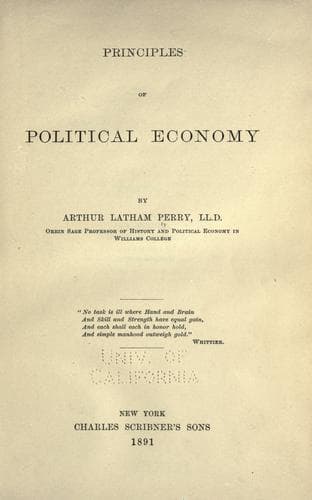
Principles of Political EconomyPerry, Arthur Latham
General
Principles of Political Economy
Perry, Arthur Latham
Economics
Serfdom once existed in England, and threw its shade over free
laborers there long after itself had disappeared. A class of indented
servants pervaded all the New England Colonies, and a clause of the
New England Confederation of 1643 provided for their forced rendition
from Colony to Colony, and passed over almost verbally into the
Constitution of the United States of 1787 as applicable to the slaves
of the South. In this way in all parts of this country manual laborers
came to be more or less off color, and this has continued in a
continually lessened degree till this time. When those who work with
their hands are looked down upon by those who do not, two sets of
feelings are apt to be engendered equally unfortunate to the two
classes that entertain them. The non-manual workers, the employers,
are more or less puffed up with pride and a sense of superiority
(there are beautiful exceptions) as towards their laborers, and the
latter in their turn are apt to develop alongside an unmanly servility
and an apparent deference, a sort of secret breasting up of hostility
and defiance, which is sure to manifest itself when labor troubles
come on even when it has not helped to brood these troubles into life.
The parties then are not well placed as towards each other to
negotiate and to compromise and to coalesce in a future harmony. The
party of the first part is too proud to yield to their inferiors, and
the party of the second part is too bitter to be sweetened. Who is
sufficient for these things? And what is the remedy for them?
Public-domain text, read in full here on John Shaqi.
Reviews
Reviews
No reviews yet
Be the first to share your thoughts on this work.
Elsewhere in the archive
Join the Discussion
Join the discussion
Sign in to leave a comment or review.
Sign InorCreate an account