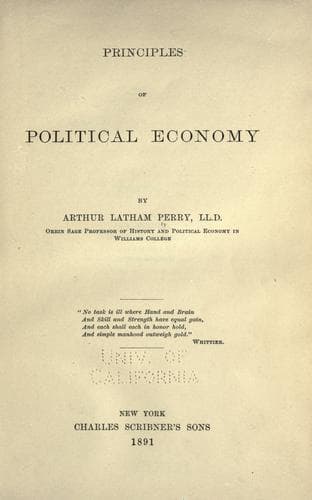
Principles of Political EconomyPerry, Arthur Latham
General
Principles of Political Economy
Perry, Arthur Latham
Economics
But the damning difficulty with this governmental business association
is, after all, in the inevitable _lack of motive_ on the part of the
hired men doing the buying and selling. It is an honor to human
nature, that hired men never have and never can have the zeal and
enterprise of principals and owners to forecast and to perform and to
lay up; because it shows that man is a rational animal, made in the
image of his Maker, always acting under the pressure of personal
motives, and always estimating what is his own more highly than what
belongs to another. Business motives act in their fulness only on the
individual, whose is the effort and whose is the return. Any policy
whatever on the part of Government, which lessens the number and the
eagerness of individual operators in favor of great artificial
combinations resting in the shadow of the Law, lessens of necessity
the gains of exchanges, and the progress of the nation, because it
lessens of necessity the press of motive on the many to work and save.
Government, accordingly, is quite too far off in every respect from
the business, that is to say, from the buying and selling of the
people, to undertake any branch of it when "it becomes necessary to
abandon the principle of freedom in the establishment of enterprises."
It will then be high time to "abandon" the "enterprises" themselves.
If the "principle of freedom" cannot compass the "establishment of
enterprises," is it likely that the "principle" of secondary and
irresponsible agents can do it? To show the people how to make their
bargains, how to buy and sell and save and spend, is a function
government is not fitted for, was not established to perform, and
never undertook without making a botch of it.
In the Preamble of the Constitution of the United States there is a
careful and complete and elegant enumeration of the purposes, which
the body of the instrument was designed to attain. These purposes are
six. No one of them contains even a hint of any purpose to enter upon
the "establishment of enterprises," still less of any necessity "to
abandon the principle of freedom." The last of these six purposes is
phrased: "AND TO SECURE THE BLESSINGS OF LIBERTY TO OURSELVES AND OUR
POSTERITY." The liberty to buy and sell freely was precisely that
"liberty" of the Colonies which was most threatened and infringed by
the British Government, to vindicate that special "liberty" was the
chief cause of the American Revolution, and "to secure the blessings"
of that and other forms of similar "liberty" was the final purpose of
the Constitution of the United States.
Public-domain text, read in full here on John Shaqi.
Reviews
Reviews
No reviews yet
Be the first to share your thoughts on this work.
Elsewhere in the archive
Join the Discussion
Join the discussion
Sign in to leave a comment or review.
Sign InorCreate an account