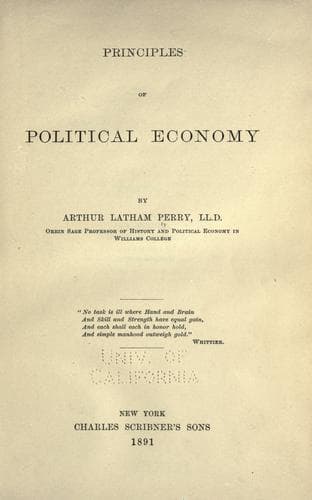
Principles of Political EconomyPerry, Arthur Latham
General
Principles of Political Economy
Perry, Arthur Latham
Economics
It is true indeed that the Constitution empowers Congress, a creature
of the People, "_to establish Post Offices and Post Roads_"; but the
purpose of this was _political_, and not pecuniary; it was to bind all
the States together in one Union of intelligence and intercourse; it
was to keep the outlying and distant parts in touch with the central
and seaboard; it is not in any sense a "business" enterprise; the
department of the mails is not now and never has been, for any length
of time, self-supporting; and it illustrates through and through in
its "Star route frauds" and other contracts, in its appointment and
removal of postmasters, and in the sickening dependence of primal
Service of the people on partisan and corrupting impulses, many of
them inherent evils of the much-vaunted Nationalism.
But besides all these vital and political objections to the assumption
on the part of government of any direct industrial functions whatever,
there remains two other fundamental objections, of which the first is,
that our national government has received no powers to any such end,
and is emphatically prohibited in the Constitution itself from
exercising them:--"THE POWERS NOT DELEGATED TO THE UNITED STATES BY
THE CONSTITUTION, NOR PROHIBITED BY IT TO THE STATES, ARE RESERVED TO
THE STATES RESPECTIVELY OR TO THE PEOPLE."
(2) The second remaining objection is, that such proposed action of
government could have no tendency at all either to enlarge the
Wages-portion, or to increase the industrial efficiency of the
laborers, or to diminish the number of competitors at any one point of
the wages-scale. As a matter of fact, such governmental action would
have precisely the opposite effect at each of these three vital points
of wages: employers would have less motive to swell the wages-portion,
laborers less motive to improve their capacity, and more motive to
congregate locally. Suppose, that at some given point in the scale of
wages, free and intelligent competition has been had on both sides,
and that the average rate of wages as thus determined proves one
dollar per day for each laborer. Suppose further, that everybody
outside the employers thinks this is quite too little, and that
government accordingly issues a decree that wages at that point must
be thereafter one dollar and a half per day. That decree can have no
tendency at all to enlarge the _wages-portion_ of those particular
employers, because _that_ has already been determined for the next
industrial cycle by the general productiveness of the cycle last past,
and by the last division under free competition between wages and
profits; if, therefore, the decree were carried out, as it never
practically could be, the result would be that only two-thirds of the
laborers previously employed could be employed then at all, and the
remaining third would certainly be worse off than before; and besides
the Division of Labor being necessarily lessened, production would be
Public-domain text, read in full here on John Shaqi.
Reviews
Reviews
No reviews yet
Be the first to share your thoughts on this work.
Elsewhere in the archive
Join the Discussion
Join the discussion
Sign in to leave a comment or review.
Sign InorCreate an account