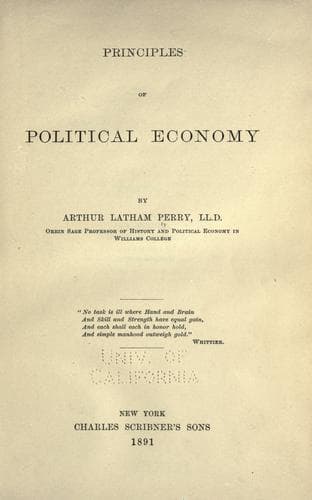
Principles of Political EconomyPerry, Arthur Latham
General
Principles of Political Economy
Perry, Arthur Latham
Economics
These masters thus organized with their laborers were the capitalists
of their time, and in this vital matter differed from the Unions of
to-day, which are made up of laborers as such organized to confront,
and if need be, to antagonize, capitalists. A royal charter was
indispensable to the legal existence of those craftsmen. It took money
for them to start their guilds, and in progress of time most of them
became very rich. "A common fund was raised by contributions among the
members, which not only provided for the trade objects of the guild;
but sufficed to found chantries and masses, and set up painted windows
in the church of their patron saint. Even at the present day the arms
of the craft-guild may often be seen blazoned in cathedrals side by
side with those of prelates and kings." This radical difference
between the two must always be borne in mind in all arguments and
inferences drawn over from the mediæval "unions" to those of the
present day.
Two points may be freely conceded to these labor-organizations before
we pass to the economic objections to them. In the first place, the
employers _set the example_ for the employees in a tacit if not open
combination as against the employees in their own interest and
emolument. The so-called "protective" tariff, for instance, is nothing
in the world but a strongly-linked combination of certain rich
capitalists to extort from the masses (their own laborers included)
artificially lifted prices for the necessaries of life; and the
certain result of shutting out imports by tariff-taxes is the
shutting in of would-be exports, to the certain lowering of general
wages in a country, because there is a lessened demand for laborers in
consequence. For a second good instance of combinations as against
employees on the part of employers, take the well-known understanding
among manufacturers of the same sort of goods in the same general
locality, that laborers discharged from one establishment shall not be
hired in any of the rest; and that if the general voice call for a
"shut down," or for three-fourths time or less, all in that line of
goods shall comply. How can laborers be blamed for organizations in
their own behalf when they find themselves confronted as individuals
with an organization of employers?
Public-domain text, read in full here on John Shaqi.
Reviews
Reviews
No reviews yet
Be the first to share your thoughts on this work.
Elsewhere in the archive
Join the Discussion
Join the discussion
Sign in to leave a comment or review.
Sign InorCreate an account