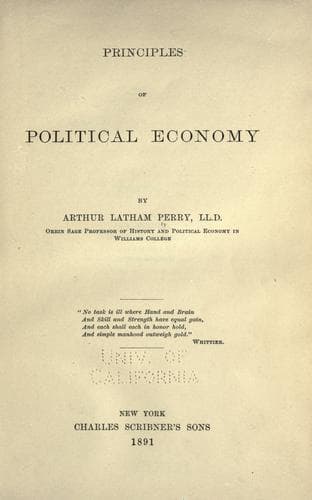
Principles of Political EconomyPerry, Arthur Latham
General
Principles of Political Economy
Perry, Arthur Latham
Economics
Then, too, it must be acknowledged, that, had it not been for united
action of some sort on the part of the laborers, the unreasonable
hours of fifty years ago in mills and factories would probably not
have been shortened to this day. Capitalists as a class are
conservative of methods, as well as of ends. The cotton and woollen
manufacturers of Berkshire County, for example, who may doubtless be
taken as a fair sample of the manufacturers of New England, stiffly
refused the demands of their work-people that the hours might be
reduced from an average of 14 throughout the year to an average of 11.
When the late Civil War was going on, and the manufacturing became
extremely profitable, and the mills were more or less depleted by
enlistment, and the remaining hands felt more independent from the
consequent rise of wages, the combined demand in one mill for fewer
hours was reinforced by simultaneous demands for the same in other
mills in the neighborhood (the time and manner having been agreed upon
beforehand), and visits in force by the work-people from mill to mill
completed the desired reform. The mill-owners were sullen and
indignant, and submitted of necessity. The work-men were right. The
reform was imperative. Credit must be given to them for the good they
have done acting as a body on this and other occasions.
On the other hand, all this is not _business_. All this is contrary to
the very old, and the very good adage, that it takes _two_ to make a
bargain. If we express this adage in the language of our science, it
will take some such form as this: When two men have mutual services to
exchange, let them come to a fair agreement as to the terms on which
they will exchange. Certainly, let each make the best terms he can,
but let the bargain always be free. If one party, who happens to have
the power to do it, uses anything like compulsion upon the other, it
ceases so far forth to be a bargain at all, and becomes a sort of
robbery, of which in some cases courts will take cognizance. Now,
workmen bring a certain valuable service to the market, just such a
service as the capitalist wants, and he has to offer just such a
service as they want, namely, wages: let the two parties come to a
free and fair agreement on the terms of their exchange; let each
workman by all means make the very best terms he can, insisting to the
last penny on all he can get elsewhere, for the value of his service
is determined, as other values are determined, by what it will bring:
let the employer do just the same on his side, and so let a fair
bargain for the time present be struck. This is a very good kind of
_striking_, and the more intelligence and skill and self-respect a
workman has, the better prepared he is to strike the bargain and
secure his just due by and for himself alone; and this gives a good
chance for every man who has any peculiar gift, who may have surpassed
his fellows in diligence and skill, to secure a proportionate reward
Public-domain text, read in full here on John Shaqi.
Reviews
Reviews
No reviews yet
Be the first to share your thoughts on this work.
Elsewhere in the archive
Join the Discussion
Join the discussion
Sign in to leave a comment or review.
Sign InorCreate an account