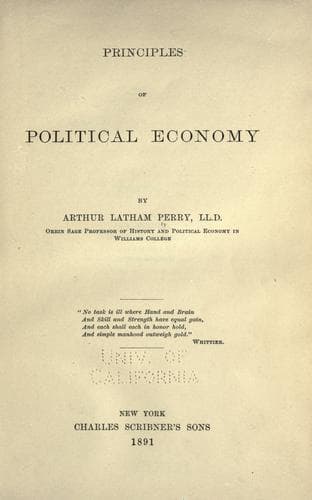
Principles of Political EconomyPerry, Arthur Latham
General
Principles of Political Economy
Perry, Arthur Latham
Economics
now and to go on higher in future; all this gives opportunity for
_diversity of relative advantage_, which, as we have seen, lies at the
basis of all exchange, which itself starts in individualism and
naturally proceeds in a still higher individualism to the end. This is
the only way for a laborer of talent and diligence to secure fully
what belongs to _him_ as a man and a workman. If he cannot get from a
given employer what he thinks he ought to get, what he thinks the
service is worth in another market, let him exercise his perfect right
to quit and go elsewhere. All this is fair and aboveboard and
individual and progressive.
Everybody knows that there is a kind of _striking_ now in vogue wholly
different from this, in that it brings a sort of compulsion into play.
_A fair bargain should be broken, if at all, just as it was made, with
the two parties face to face, and everybody else aloof; and a new
bargain should be made, just as the old one was, with the two parties
face to face, and everybody else aloof._ But a combination among
workmen to leave an employer in the lurch, and especially a
combination which forces into its ranks by cajoling or menaces those
who are unwilling to join it, as is so commonly the case in Strikes,
is not only contrary to the inmost nature of a bargain, but is also of
itself a sort of confession of the injustice of the claim. If the
claim be just so far as _all_ the individuals are concerned, there is
no occasion to extort it. If the value of the service rendered by each
be equal to the sum demanded, and especially if this can be obtained
elsewhere, which is the only gauge of the value of any service
anywhere, there is no need of conference and combination and
conspiracy. Of course, this radical argument against Strikes implies
that employers of that grade have not entered into a combination not
to hire dissatisfied laborers from other establishments; if they have,
then the agreement can be turned with equal force against the
employers themselves, for _they_ are resorting to means outside the
nature of a bargain, means of the same nature as a Strike. Let, then,
each workman tell his employer the present facts just as they are, and
if this appeal prove ineffective to secure his commercial right, let
him go quickly where he can get the most for his service. That this is
not done, that means of the nature of a threat are brought to bear
upon the employer, that the justice of the claim is not relied on in a
case where more than anywhere else justice can enforce itself, that
free and full explanations are not had, that no notice is given, that
great damage is expected by their action to accrue to the
employer,--all this seems to forget that the transaction between
employers and employed is a case of pure exchange, a simple bargain of
one service against another service.
Public-domain text, read in full here on John Shaqi.
Reviews
Reviews
No reviews yet
Be the first to share your thoughts on this work.
Elsewhere in the archive
Join the Discussion
Join the discussion
Sign in to leave a comment or review.
Sign InorCreate an account