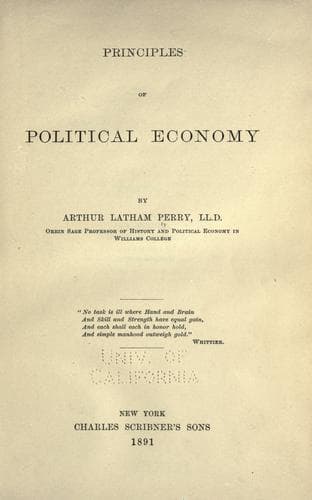
Principles of Political EconomyPerry, Arthur Latham
General
Principles of Political Economy
Perry, Arthur Latham
Economics
In this country, where there is nothing to hinder any laborer from
becoming a capitalist, where the savings-banks are open to the
smallest gains, where nothing is more common than for two or more
workmen to organize a firm to carry on some branch of business, where
most of the present capitalists proper were formerly laborers proper,
and where the shares of most of the joint-stock companies are open to
everybody who has the means to buy them, there is only one
consideration that seems to justify any special jealousy of laborers
as such towards capitalists as such; and that is the fact, that
Legislation, every now and then, sometimes on a small scale and then
on a gigantic one, now by means of corporate charters and then by
other means more indirect and effective, _does confer certain
extraordinary privileges upon capitalists_. So long as capitalists and
laborers rest upon their natural rights and positions, neither can get
any undue advantage of the other; and just so far as each recognizes
their identity of economic interest and the consequent reciprocity of
obligation and effort, the prosperity of each will help build up the
other; but, on the other hand, so far forth as any advantages are
given to capitalists by special laws, either of State or Nation, these
become necessarily unjust to laborers, and ultimately also injurious
to capitalists; and in this case, the laborers, seeing just what it is
that hurts them, _ought to combine together and to strike, not capital
(their best friend), but a piece of perverted legislation (their worst
enemy)_.
FOOTNOTES:
[5] O'Reilly's Poem, at Plymouth, 1889.
[6] Green's Short History of the English People, p. 144.
CHAPTER IV.
COMMERCIAL CREDITS.
Political Economy is the Science of Sales; and because it _is_ the
science of sales, its definitions and principles must cover equally
all cases of sales actually occurring or possible to occur. We have
seen repeatedly, that only three kinds of things are ever bought and
sold, or ever will be, and these are Commodities and Services and
Claims. The first two kinds have been fully elucidated already in the
two preceding chapters, and it belongs to the present chapter to
explain and illustrate clearly the peculiarities of the third kind of
things salable. Ours is the only science that has to do with the
motives and facts and economic results of all sales as such.
The discussions of the present chapter will proceed orderly through
the following topics:--
_The Nature of Credit._
_The Forms of Credit._
_The Advantages of Credit._
_The Disadvantages of Credit._
Public-domain text, read in full here on John Shaqi.
Reviews
Reviews
No reviews yet
Be the first to share your thoughts on this work.
Elsewhere in the archive
Join the Discussion
Join the discussion
Sign in to leave a comment or review.
Sign InorCreate an account