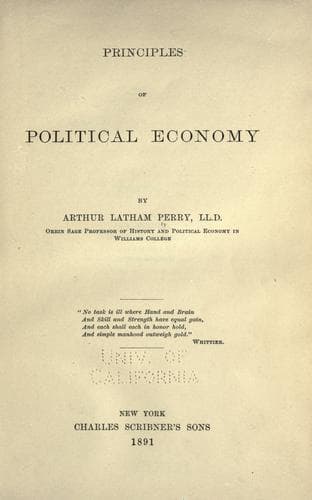
Principles of Political EconomyPerry, Arthur Latham
General
Principles of Political Economy
Perry, Arthur Latham
Economics
1. Certain things are essential in every sale of anything, and of
course are common to all sales of everything, such as two persons and
two desires and two estimates and two renderings; while there are
certain _peculiarities_ in the sale of things belonging to each of the
three special classes of things salable; for example, in the sale of a
commodity there is a rendering of a tangible object that has been
prepared for sale in past time, and in the sale of a service a
rendering of an intangible something wholly in the present time; while
in the sale of a credit there are likewise two peculiarities, one of
them relating to future time and the other to a special trust felt in
a person by some other person. We must now study these two
peculiarities with care; and, mastering these, we shall be master of
the Nature of Credit.
a. Some sales are consummated at once, the things exchanged and the
ownership in them are mutually passed over then and there, the
reciprocal satisfactions are entered upon immediately, and there is at
once an economical end.
For example, one neighbor sells another a peck of green peas and takes
in pay a peck of new potatoes, both vegetables may be cooked for
dinner in the respective families the same day, and the commercial
transaction is all over. But there are other exchanges, an immense
class of them, different from these in this respect, that though the
transaction considered as a mere case of value created and measured is
then and there ended, yet considered as to the nature of that
preliminary exchange which implies and requires another future
exchange to consummate it, it is not then and there ultimately closed,
but one (or both) of the parties then exchanging relies on the good
faith of some one else to fulfil in the future a pledge expressly or
impliedly made in the prior exchange. Commonly some external evidence
of the pledge is created and passed at the time, but this is not
essential to the validity of the pledge itself. For example, A buys 50
bushels of wheat of B, and B takes in pay for it A's note of hand at
six months for $75. The note is not the pledge, but it is a legal and
convenient proof of it. As a case in Value, the wheat is sold for the
pledge and the pledge is the equivalent of the wheat. Each party
rendered the other then and there satisfactory equivalents. All our
definitions apply here perfectly.
Public-domain text, read in full here on John Shaqi.
Reviews
Reviews
No reviews yet
Be the first to share your thoughts on this work.
Elsewhere in the archive
Join the Discussion
Join the discussion
Sign in to leave a comment or review.
Sign InorCreate an account