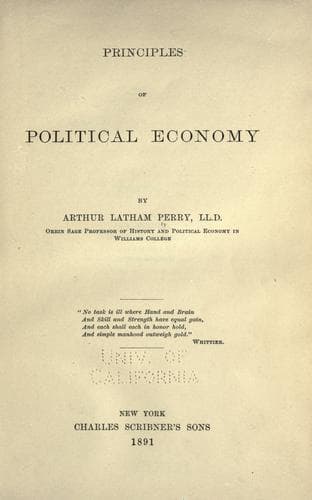
Principles of Political EconomyPerry, Arthur Latham
General
Principles of Political Economy
Perry, Arthur Latham
Economics
b. The other and final peculiarity of Credit is, that it always
involves on the part of one person a commercial confidence in some
person _as such_. The term, Credit, is derived from the Latin CREDO,
_I believe_, and the corresponding term, Debt, from DEBEO, _I owe_.
Thus the personal element and the future element are wrapt up in the
very origin of the words. There is no credit without debt, and no debt
without credit. The very words imply a _belief_ of one of the two
parties in a commercial promise made by the other, and also an
_obligation_ acknowledged by this party as due to the first. There is
a basis for credit in human nature. Faith in each other to a certain
extent is natural to men. Whatever enlarges the intellectual
foresight, and especially the moral character of men, opens a broader
and surer field for Credits. Civilization, so-called, and Christianity
certainly, deepens and broadens the natural trust of man in man.
Despite all the instances of broken faith, and they are too many;
despite the shocks and cautions that come every now and then to every
man who trusts much in his fellow-men; experience itself justifies and
rewards an ever-growing commercial trust. It is one of the noble
things in international commerce, as we shall see, that men trust each
other across the oceans, and lay millions of value upon the faith of a
single firm. As the core of the Christian religion is confidence in a
_Person_, so the very substance of credits is a natural and in general
well-grounded faith in _persons as such_.
A Credit, then, may be defined to be _a Right to demand something of
somebody_; and a Debt to be _an Obligation to pay something to
somebody_. What always lies, accordingly, between creditors and
debtors, are Rights coupled with Obligations; and these are
_Property_, just as much as anything is and for the same reason, since
they always may be, and usually are, bought and sold by other parties
as well as the original parties. In these Rights or Claims,
therefore, arises a commerce, domestic and foreign, immense in extent
and amount, and the Rights themselves take their undisputed place on
an equality with tangible Commodities and personal Services.
Having thus reached an ultimate and satisfactory definition of Credit,
we must still pursue a little further our present object, namely, to
obtain a clear conception of the _nature_ of this great class of
Valuables, by drawing two or three distinctions between Credit-Rights
and some other rights very apt to be confounded with them.
Public-domain text, read in full here on John Shaqi.
Reviews
Reviews
No reviews yet
Be the first to share your thoughts on this work.
Elsewhere in the archive
Join the Discussion
Join the discussion
Sign in to leave a comment or review.
Sign InorCreate an account