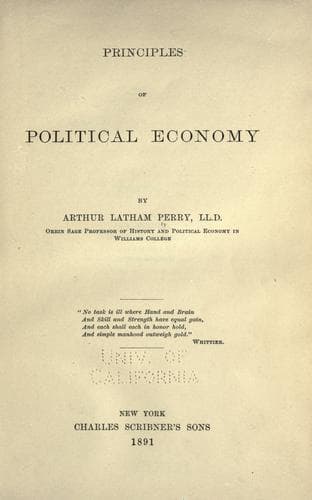
Principles of Political EconomyPerry, Arthur Latham
General
Principles of Political Economy
Perry, Arthur Latham
Economics
(1) The distinction between credit-rights and other rights is well
rooted in the Latin language and in the Roman law, while the
corresponding English terms are quite ambiguous and need to be used
with great caution. In Latin, a true debt is called a _Mutuum_,
because it lies between two persons, a creditor, and a debtor, and is
a credit-right independent of the question of fact whether the debtor
has now the thing rendered to him or not, indeed whether he has
anything at all to pay with or not; on the other hand, a thing merely
lent, when the very thing lent is to be returned to its owner, who has
not in the meantime parted with his property to the other, is called
in Latin a _Commodatum_. The English tongue has but the one word,
_Loan_, for the two very distinct operations: for the loan of a book,
for instance, which is to be returned after use, and which may be
legally reclaimed by the owner if he chance to find it anywhere, that
is, the Latin _commodatum_; and for the loan of money, or other such
measurable thing, which is to be returned _in kind_ only, and which
may _not_ legally be reclaimed except through some action of the
borrower, since the ownership of that thing rendered has passed over
to him completely, that is, the Latin _mutuum_. The same ambiguity of
course inheres in the corresponding English word, _Borrow_. The
English language is relatively poor in words expressing nice legal
distinctions.
Now, as a true debt is a claim on a _person_ and never on a _thing_,
the Roman Law is true to the nature of things and to the vital
distinctions of our science, when it names the right to which a
_mutuum_ gives birth as a _jus in personam_, that is to say, a right
against the person; while it names the legal obligation arising out of
a _commodatum_ as a _jus in re_, that is to say, a right to the very
thing. So strongly is this doctrine, namely, that the security of a
true debt lies against persons and not against things, intrenched in
the Roman Law, that debts or credits are even termed "_nomina_,"
_names_, in that law, as when Ulpian says, "_Nomina eorum qui sub
conditione vel in diem debent et emere et vendere solemus_": We are
accustomed to buy and sell DEBTS payable on a certain day and at a
certain event. The fundamental law of the present national banks of
the United States explicitly recognizes this old and good distinction
by requiring the banks to loan money on _personal_ security only, that
is to say, no tangible things, not even real estate, may be taken as
_original_ security for any loan.
Public-domain text, read in full here on John Shaqi.
Reviews
Reviews
No reviews yet
Be the first to share your thoughts on this work.
Elsewhere in the archive
Join the Discussion
Join the discussion
Sign in to leave a comment or review.
Sign InorCreate an account