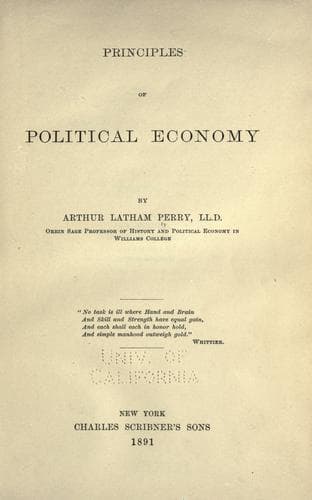
Principles of Political EconomyPerry, Arthur Latham
General
Principles of Political Economy
Perry, Arthur Latham
Economics
bearers, and these in turn are _creditors_, and the legal-tender
quality of the greenbacks does not alter their character as a form of
pure credit. Both the elements of good faith and future time inhere in
the greenbacks, as they do also in the bonds of the United States,
while in the certificates neither of these elements appears.
However, circumstances easily conceivable and which were actually
realized in the case of the famous Bank of Amsterdam, founded in 1609,
might make the United States a debtor and the holders of the silver
certificates creditors in the commercial sense of those terms. The
Directors of the Bank of Amsterdam, towards the close of the second
century of its beneficent existence, loaned out to the Dutch East
India Company and to the City of Amsterdam large parts of the bullion,
on which its certificates ("bank money") were based, unknown to the
public, which felt unlimited confidence in the bank, and the result
was in 1795, when the French invaded Holland and the facts became
known, that bank money which had previously borne a premium of 5% fell
at once to a discount of 16%, although the bullion that remained and
the debts due the Bank were fully equal to redeem the certificates and
were used for that purpose. So, if the United States should use,
clandestinely or otherwise, the silver dollars for other purposes than
to redeem the certificates on demand, the latter would undoubtedly
both in law and fact be transformed from mere token-money (as now)
into credit-money valid as against the United States as debtor, like
the greenbacks at present.
Have we now compassed our first object? Do we fully understand, from
the foregoing descriptions and distinctions, the _Nature_ of Credit?
If so, we are prepared to look narrowly into its _Forms_.
2. Credit-rights are commonly, but not always, recorded upon paper;
but it is important to observe, that the paper-document is the mere
evidence of the right, and not the right itself, which lies back of
the paper as substance to shadow, and persists intact even were the
paper lost or destroyed. These paper instruments of Credit are
commonly contemplated as of two kinds, Promises to pay and Orders to
pay, but there is not at bottom any radical difference between these,
the Right as between two persons is not affected by this superficial
difference, as we shall see, and the present enumeration of
credit-forms will proceed independently of it.
Public-domain text, read in full here on John Shaqi.
Reviews
Reviews
No reviews yet
Be the first to share your thoughts on this work.
Elsewhere in the archive
Join the Discussion
Join the discussion
Sign in to leave a comment or review.
Sign InorCreate an account