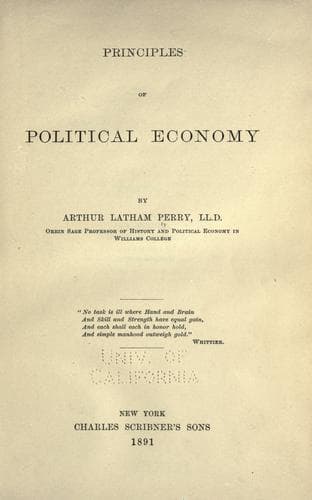
Principles of Political EconomyPerry, Arthur Latham
General
Principles of Political Economy
Perry, Arthur Latham
Economics
(3) Attention should be called to a third distinction of the same
general nature, as between relations very different in themselves and
yet extremely liable to be confounded with each other. Let us take a
common instance: a customer of a bank takes a package of valuables of
any kind to his banker, such as bonds and bills payable and jewels and
plate, and asks him to take care of it for the present in his vault,
subject of course to a return to him or any one else to his order at
any time: no property in these valuables passes over to the banker, it
is not a deposit in the ordinary banking sense, the relation of debtor
and creditor does not arise as between banker and depositor, the
banker becomes Trustee or Bailee of the package, and is bound to
exercise common vigilance in the care of it, but if it be burned or
stolen extraordinarily the loss is the customer's and not the
banker's. But now, on the other hand, when a customer deposits in the
banking sense money or bills payable with his banker, the property in
the money and bills passes over to the banker instantly, the relation
of debtor and creditor arises, the depositor receives a credit on the
banker's books in return for the money and bills rendered, the
exchange as a mere case of value is consummated to the profit of both
parties, but the return-service to the depositor is _the right to
demand equivalents of the banker at some future time_. In other words,
it is a case in Credit.
(4) As this general distinction is vital, we shall lose nothing in the
end if we make even a fourth exemplification of it. The United States
Treasury receives silver dollars of its own minting from any person
who chooses to place them there, and gives out in token what are
called "Silver certificates" to the same amount, entitling the bearer
to take out the dollars again at will, and thus the certificates being
more convenient than the dollars and just as valuable become a part of
the money of the country. The Treasury is bound to exercise due care
in the keeping of these silver coins, and to return them to the
holders of certificates on demand, just as the elevator and railroad
companies are under legal obligations to show diligence in keeping and
transporting the wheat of our former example; but the United States is
not _debtor_ to the holders of these certificates any more than the
elevator company is _debtor_ to the wheat shipper, and consequently
there is no element of Credit in these certificates. Just so of the
later gold certificate. On the other hand, the so-called greenbacks
issued by the United States are also a part of the money of the
country, but they are _credit_-money, inasmuch as they are a _promise_
to pay to the bearer some time in the future so many dollars. The
Treasury has never kept up any special fund of gold and silver, with
which to redeem the greenbacks. They rest back for their value on the
good faith of the country. The United States is _debtor_ to the
Public-domain text, read in full here on John Shaqi.
Reviews
Reviews
No reviews yet
Be the first to share your thoughts on this work.
Elsewhere in the archive
Join the Discussion
Join the discussion
Sign in to leave a comment or review.
Sign InorCreate an account