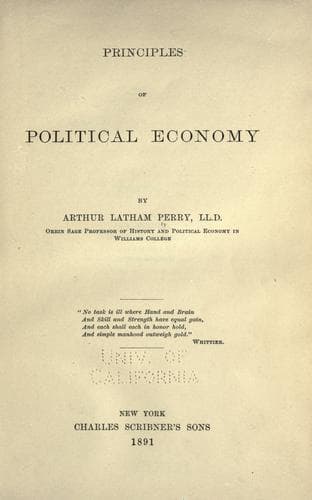
Principles of Political EconomyPerry, Arthur Latham
General
Principles of Political Economy
Perry, Arthur Latham
Economics
Nations too are moral persons in the same loose though binding sense
as corporations, and as such often issue promissory notes on interest,
commonly called in this country Bonds, in Great Britain Funds, and in
some countries Stocks. These are always pure credit. Nations give no
mortgages. Yet they often borrow at a less rate of interest than the
most solvent individuals or corporations can, as is seen by the fact,
that British consols carry but 3%, and yet bear a premium in the
present market. The term, "consols," is a popular contraction of
"consolidated annuities," the Act to create which at 3%, out of a then
confused mass of public debts at various rates of interest passed
Parliament in 1757. The maximum of the British debt was
$4,500,000,000 in 1815, and has now decreased to $3,467,787,960.
The United States also sold its bonds at 3% for a small premium in
1882. It had borrowed of its own citizens in 1862-65, both inclusive,
about $2,500,000,000 on its bonds at different rates of interest and
at different times of repayment: some of these bore gold interest at
6% annually, Government reserving the right to pay the principal in
five years and pledging itself to pay it twenty years from date, and
so these bonds were called "Five-twenties"; others bore gold interest
at 5%, becoming payable at ten and demandable at forty years, and so
were called "Ten-forties"; and still others bore greenback interest at
7-30/100%, the principal payable in greenbacks at three years, or
fundable in gold sixes, at the option of the holders, and these were
named "Seven-thirties." Over $90,000,000 of this last kind of bonds
were subscribed for by the American people in the course of a single
week in the spring of 1865. The whole of our national debt issued
prior to 1865 was made payable on a day certain; the so-called
"consols" of 1865 and 1867 and 1868 were payable _not more_ than forty
years from date; while all the bonds authorized from 1870 to 1882 were
Consols proper, whose peculiarity is, that they never fall due so as
to become a claim for the principal against the Government, but after
a day fixed or on a condition fixed are payable "at the pleasure of
the United States."[7]
Public-domain text, read in full here on John Shaqi.
Reviews
Reviews
No reviews yet
Be the first to share your thoughts on this work.
Elsewhere in the archive
Join the Discussion
Join the discussion
Sign in to leave a comment or review.
Sign InorCreate an account