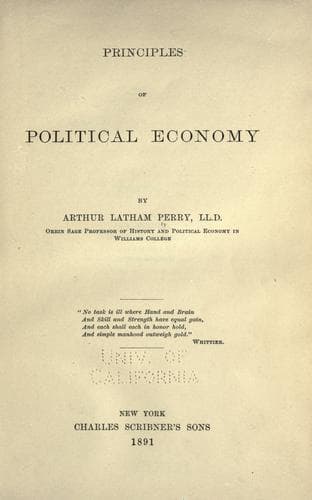
Principles of Political EconomyPerry, Arthur Latham
General
Principles of Political Economy
Perry, Arthur Latham
Economics
The separate States of our Union, as sovereign in their own sphere
quite as much as the national Government is sovereign in its sphere,
have unlimited power to contract debts for State purposes through
their regularly constituted authorities; and consequently to issue
promissory notes or bonds to liquidate such debts. New York commenced
in this way in 1817 the magnificent enterprise of the Erie Canal, to
connect the great Lakes with the city of New York by an inland
water-way for commerce, and the completion of this in 1825 made the
State the "Empire State," and the city the undisputed commercial
metropolis of the Union. In a similar way Massachusetts undertook in
1862 the completion of the Hoosac Tunnel for a railway lengthwise of
the State; and although the process became unduly expensive, and great
abuses sprang up in connection with it, no one now questions that the
pecuniary and moral resources of the State have been augmented, on the
whole, by contracting the debt and providing by taxation for the
liquidation of both interest and principal. The credit of
Massachusetts, that is, the ability to borrow money at low rates of
interest, has been at times greater than that of the United States;
mainly because the State in 1862 and onwards refused to avail itself
of a depreciated national paper-money (greenbacks) made legal tender
for all debts, with which to pay the interest on its then existing
State debt, but persisted throughout (alone of the States) to pay that
interest so soon as due in gold coin. On the other hand, several of
the States of the Union at different times, and under more or less of
provocation and justification, have made a partial or entire
repudiation of certain portions of their public debts, justly damaging
to their individual credit, and even to the good name abroad of the
whole people of the United States.
Counties and cities and towns may also issue interest-bearing bonds
for public improvements, which have a _quasi_ governmental character,
but only under conditions and to a maximum amount prescribed by a law
of the State.
Public-domain text, read in full here on John Shaqi.
Reviews
Reviews
No reviews yet
Be the first to share your thoughts on this work.
Elsewhere in the archive
Join the Discussion
Join the discussion
Sign in to leave a comment or review.
Sign InorCreate an account