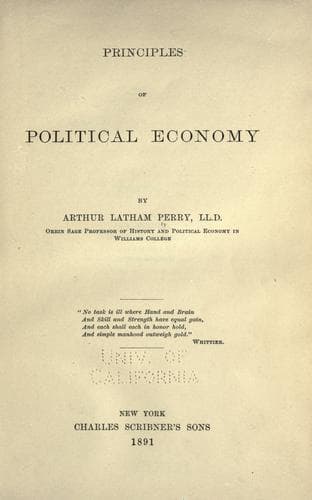
Principles of Political EconomyPerry, Arthur Latham
General
Principles of Political Economy
Perry, Arthur Latham
Economics
Under these circumstances the Second Bank of the United States went
into operation in January, 1817, also with a charter to run twenty
years, with a capital stock of $35,000,000, of which the national
Government subscribed one-fifth. The new Bank helped indeed the State
banks to resume specie payments, as was a part of the purpose, but it
pushed its own bills into circulation with such eagerness, that it is
thought $100,000,000 of them were in the hands of the people, before
the first year was out. In this way the Bank fell into difficulties.
Its bills were distrusted. Coin came to bear a premium over them of
10%. President Jackson began his famous contest with the Bank seven
years before its charter was to expire, and took care that it went out
of being the same year that he went out of office, in 1837, namely.
The next year the State banks increased in number to 675, and
continued to increase till 1862, when there were over 1500 of them,
and when the issue of the "Greenbacks" by the national Government
interfered with what had been their exclusive issuing of the paper
money after 1837. In 1857, before the commercial panic of that year,
the aggregate of their bills stood at $214,000,000, the largest it
ever reached. These bills were nominally convertible into coin at the
will of the holders, but they were never actually so convertible for
any great length of time. The ratio of their volume to the specie
reserved to redeem it was always a very high ratio. For instance, the
average for the whole country in January, 1863, was 4:1; in Rhode
Island 12:1; and in Vermont 28:1. Such a paper money can be called
convertible only by a stretch of courtesy.
It was wisely determined by the People to abandon this loose form of
paper money, and in 1863 went into operation the present national
banking system, under which originally $300,000,000 of bank bills were
authorized to be issued in the aggregate, but this limit was extended
in 1870 to $354,000,000, and the Act of 1875 removed all restrictions
on the total amount, while there have always been restrictions on the
amount that can be issued by any _one_ bank in the system. By the law
of 1882, national banks may withdraw their bills by depositing lawful
money in the Treasury to take them up, and then take back the
proportionate amount of the bonds held for the security of the bills.
There were outstanding Dec. 26, 1883, $341,320,256 of these national
bank bills, but their volume declined under the law of 1882 to
$151,702,809 on Oct. 4, 1888. These bills were from the first
redeemable in greenbacks, which were themselves, however,
irredeemable in gold and silver till New Year's, 1879, since which
time till the present all the paper money of the United States of both
kinds has been convertible into coin at the will of the holder.
Public-domain text, read in full here on John Shaqi.
Reviews
Reviews
No reviews yet
Be the first to share your thoughts on this work.
Elsewhere in the archive
Join the Discussion
Join the discussion
Sign in to leave a comment or review.
Sign InorCreate an account