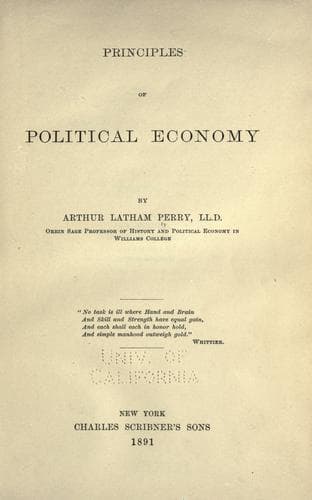
Principles of Political EconomyPerry, Arthur Latham
General
Principles of Political Economy
Perry, Arthur Latham
Economics
Bank bills, as a form of paper credit not on interest, but ostensibly
redeemable in coin on demand of the holder, have been issued in the
United States by more parties and to a larger extent and with more
recklessness as to redemption than in any other country. Omitting all
reference to Colonial issues, and confining the outlook to the first
century under the Constitution, let us note, that when the present
national government went into operation in 1789, the "Bank of North
America" in Philadelphia and the "Bank of New York" in New York and
the "Bank of Massachusetts" in Boston had been opened for business,
and all three were State banks issuing bills convertible into coin,
though each confined its business mostly to the city in which it was
located. Two years later under the auspices of Alexander Hamilton,
then Secretary of the Treasury, the first "United States Bank" went
into operation at Philadelphia under a charter from Congress that was
to run twenty years with a capital stock of $10,000,000. At first no
bills were issued by this bank of a less denomination than $10; the
money was popular and was converted on demand; the Bank was
prosperous, and paid dividends to stockholders never falling below 8%
and frequently rising to 10% annually; as the time approached for the
charter to expire, the stockholders were anxious for a renewal of
their privileges; but the opposition to them in Congress was now
strong, owing mainly to the increase in the number of State banks from
3 to 88; and accordingly the recharter was defeated in the House by
one vote, and in the Senate also, by the casting vote of the
Vice-President, and the Bank was obliged to wind up its affairs in
1811.
Then came in a sort of mania for the creation of new State banks,
under the hope that these, now there was no National Bank, might
obtain the Custody and temporary use of the national funds, and
especially might furnish the country with paper money in the shape of
State bank bills. The number of banks went up to 246 in 1816. So many
bank bills were put out, and became so much distrusted, and so many
were presented for redemption, that the banks could not respond in
coin, and in the fall of 1814, there was a general stoppage of specie
payment in all the banks of the Country excepting those in New
England. General resumption of specie payment by the banks did not
take place till 1819. New York bank bills went down to 90%, those of
Philadelphia to 82%, those of Baltimore to 80%, and those of Pittsburg
to 75%.
Public-domain text, read in full here on John Shaqi.
Reviews
Reviews
No reviews yet
Be the first to share your thoughts on this work.
Elsewhere in the archive
Join the Discussion
Join the discussion
Sign in to leave a comment or review.
Sign InorCreate an account