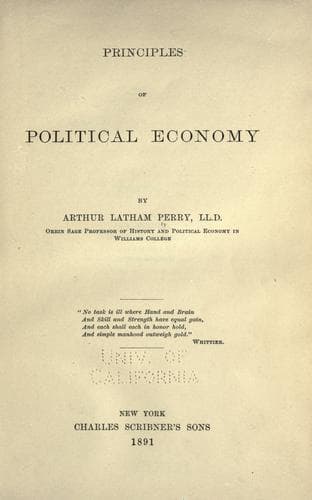
Principles of Political EconomyPerry, Arthur Latham
General
Principles of Political Economy
Perry, Arthur Latham
Economics
So, on the other hand, of the southern neighbors of the Tyrians. There
the earth brought forth by handfuls. There was an abundance of corn in
the land, even to the tops of the mountains. Its fruit did indeed
shake like Lebanon. But there were no cedars there, no fir-trees, no
sandal-woods. How short-sighted, then, and futile, would it have been
for the Jews, to try to hang on in their own behoof to all the natural
advantages that God had given to them, and to say, We will not part
with the direct results of any of them, we will build treasure-cities
as they did in Egypt, we will store up all the fruits of these fat
years against the possible coming of some famine years in the time to
come. That is anything in ordinary times but the divine plan. It is
anything but the letter and spirit of the divine injunction: "_Him
that keepeth back corn the people curse; but blessing shall be upon
the head of him that selleth it_" (Prov. xii, 26). Had they talked and
acted thus, no temple could then have been built in Jerusalem, and the
people of that generation would have lost the moral and religious
impulse and uplifting of their service and sacrifice. Their grain
would have become worthless from its very abundance, and would have
decayed on their hands. They would have missed a great gain for
themselves, and would have snatched away from their neighbors to the
northward a providential opportunity for an equal gain.
The general truth must not be lost sight of here, even in passing,
that all trade whatsoever is based upon a Diversity of relative
Advantage as between the parties exchanging products. If, for example,
the Hills of Judah and the Mountains of Israel had been covered with
timber suitable for building the temple, and the coasts of Tyre and
Sidon and the foot-hills of Lebanon had been fertile stretches of
arable land, this particular trade would never have been thought of
and could never have been realized. There would have been no gain in
it for either party, and unless there be a valid gain for both parties
at least in prospect, no trade will ever spring into being, because
there would be no motive, no impulse, no reason, in it. Unless the
Jews could get the timber easier by raising grain to pay for it, and
the Tyrians get the oil and wheat and barley easier by cutting and
floating timber to pay for them,--no trade; but the greater easiness
to each actually came about, because each had an Advantage both
natural and acquired over the other in his own rendering, and the
mutual gain of the trade was wholly owing to that circumstance. So far
as that matter went, the Tyrians had no cause to envy their neighbors
the superior soil of the south, for they reaped indirectly but
effectively a part of those harvests for themselves; and the Jews had
no reason to be jealous of their northern neighbors on account of the
noble forests crowning their mountains, because through trade they
secured easily to themselves a share of that vast natural advantage.
Public-domain text, read in full here on John Shaqi.
Reviews
Reviews
No reviews yet
Be the first to share your thoughts on this work.
Join the Discussion
Join the discussion
Sign in to leave a comment or review.
Sign InorCreate an account